


 |
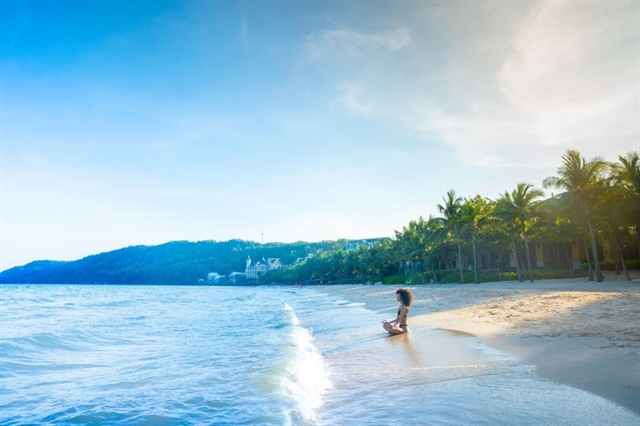
| International travelers continue to choose Phú Quốc as Việt Nam’s leading leisure destination. — Photo courtesy of Sun Group |
AN GIANG — Leading US travel magazine Travel + Leisure recently described Phú Quốc not only as Việt Nam’s tropical getaway, but as an emerging “howcase of global architectural influences” where inspirations from around the world come together in a distinctly tropical setting.
In a fresh perspective on the island, Travel + Leisure moves beyond beaches and resorts to spotlight Phú Quốc’s evolving identity. The magazine highlights how internationally inspired architectural works are increasingly shaping the destination, forming a new tourism character. These multicultural “pieces,” it notes, are gradually redefining the island in much the same way architecture has shaped many global cities.
From Singapore’s lesson to a multicultural architectural strategy
Travel + Leisure draws a comparison between Phú Quốc and Singapore, a destination celebrated for its cultural fusion. While Singapore reflects this through history and its diverse communities, Phú Quốc is expressing a similar spirit through architecture.
One of the most notable examples mentioned is Sunset Town. With its colourful facades, cascading stairways and sea-facing piazzas, the area evokes the charm of Italian coastal villages. Yet, as the magazine points out, it is not a Mediterranean replica, but rather a Mediterranean dream reimagined in Phú Quốc’s own way.
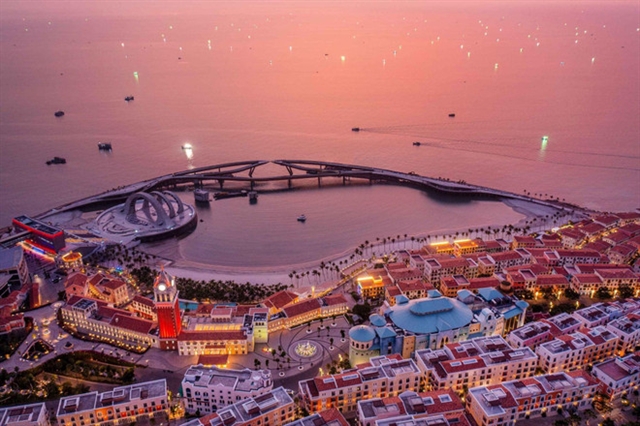 |
| Sunset Town comes alive with dazzling lights as night falls. — Photo courtesy of Sun Group |
At the heart of this architectural ensemble stands a clock tower inspired by St. Mark’s Campanile. Instead of retaining the original’s solemn single-faced clock, the Phú Quốc version has been reinterpreted with a more open, dynamic design featuring four clock faces oriented toward different streets. Nearby, the King of the Sun fountain – crafted from 30 tonnes of marble by Frilli Gallery – adds a striking artistic focal point, with the Sun God Helios riding his chariot, echoing classical European aesthetics.
On Hòn Thơm Island, Santo Port offers another reinterpretation – this time of Santorini. While the Greek original is known for its dramatic volcanic cliffs overlooking the Aegean Sea, the version in Phú Quốc feels infused with tropical vitality.
Travel + Leisure calls it an intelligent reimagining. “Many describe it as a ‘tropical Santorini’ – bright, lush and deeply rooted in Phú Quốc’s landscape… a tropical expression of Mediterranean beauty that you won’t find anywhere else in the world,” the magazine notes.
Where architectural “legends” leave their mark
Beyond its multicultural inspirations, Phú Quốc has also drawn the attention of world-renowned architects, contributing to a new generation of iconic structures. Travel + Leisure highlights how Sun Group has collaborated with leading global designers to shape the island’s evolving identity.
First arriving in Phú Quốc in 2015, “resort maestro” Bill Bensley created the striking JW Marriott Phú Quốc Emerald Bay Resort. Through his narrative-driven design approach, he transports guests into a fictional 19th-century university.
From libraries to laboratories and dormitories, every detail unfolds like part of an elaborate story, offering a stay that goes beyond the conventional. The magazine describes it as a “ultra-luxurious, highly artistic, immersive architectural universe found nowhere else on earth.”
Bensley is also behind Sun Signature Gallery at Sunset Town, a bold Mid-Century Modern structure defined by striking forms and vibrant colors.
This architectural dialogue continues with other landmark works, most notably Kiss Bridge. In contrast to Bensley’s richly detailed interiors, architect Marco Casamonti adopts a more direct approach, placing the structure in a close relationship with nature. Inspired by Michelangelo’s The Creation of Adam and echoing the Vietnamese legend of Ông Ngâu and Bà Ngâu, the bridge extends in two arms toward the sea, stopping just 30 centimetres apart – an intentional distance for a kiss, a handshake or a quiet moment at sunset.
According to Travel + Leisure, projects like these position Phú Quốc as “a meeting point for some of the world’s most imaginative architectural ideas.
The experience goes beyond architecture alone. The magazine notes that Phú Quốc’s architectural landscape is increasingly integrated with large-scale shows and events, creating a more immersive travel experience. As night falls, performances such as Kiss of the Sea and Symphony of the Sea, alongside year-round fireworks, transform the island’s south into a vibrant open-air stage. “By combining iconic architecture reimagined with a Phú Quốc twist, large-scale theatrical performances and nightly fireworks displays, this Vietnamese island is carving out a bold creative identity – one that elevates the tourism experience to new heights.” Travel + Leisure observes.
As the US travel publication suggests, this evolution is turning Phú Quốc into more than just a beach destination. It is becoming a place where visitors embark on an aesthetic journey – where architecture, art and nature come together in a single, seamless experience. — VNA/VNS
Read original story on Vietnam News