

 |
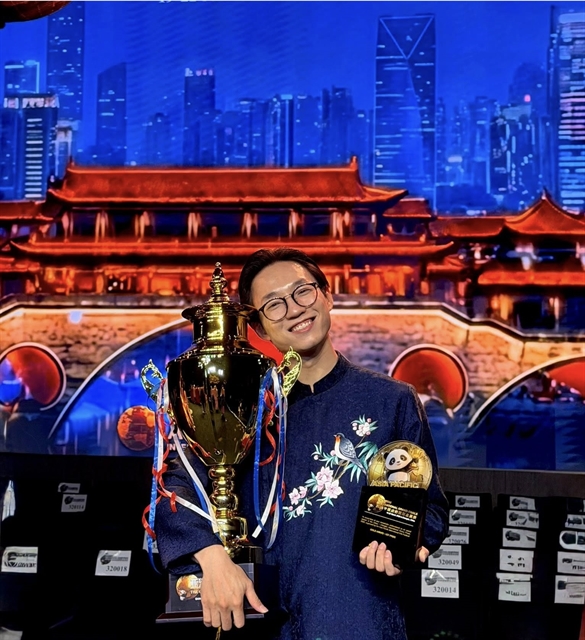
| Nguyễn Đức Hiếu holds his trophy at the Chengdu International Grand Finals of the Asia-Pacific Arts Festival in China last month. Photo courtersy of Hiếu |
Việt Nam News reporter Nguyễn Bình interviews Hiếu about the prize and his ambitions for the future.
What is your award-winning dance about?
Ballet dancers in Việt Nam have few opportunities to perform. For me, dancing is a daily necessity, so I am constantly eager to perform on stage.
I came across information about the festival on Facebook. Although it is an arts festival rather than a competition, I saw it as a valuable opportunity to connect and learn. Watching fellow performers on stage and exploring performance technology as well as staging techniques is a rewarding experience for me.
At the festival, I choreographed and performed a four-minute neo-classical ballet inspired by the song Áo Lụa Hà Đông (The White Silk Dress) from the film of the same name.
The piece reflects my personal emotional journey from a young boy who once saw the world through rose-tinted glasses and immersed himself entirely in dance.
Over time, the boy has come to realise that life has many facets and is not always filled with joy. Those realities have shaped me, prompting self-reflection and enriching my experiences.
How did you become a ballet dancer?
At the beginning, my parents wanted me to study painting. At the age of six, in 2000, they took me to a painting class at a cultural centre near my home.
However, when we arrived, the painting class was no longer being offered and a dancesport class was available instead. I ended up enrolling in dancesport.
Noticing my focus and passion for dance, and because my home is close to the Việt Nam Academy of Dance, my parents encouraged me to apply and enrol at the academy.
After my first year at the academy, I realised that ballet demands rigour, precision and exacting standards, almost mathematical in nature, yet remains refined and elegant.
It felt closely aligned with my personality, so I decided to commit to ballet. To this day, I remain fascinated and curious about ballet, even though I have explored other forms, including music and singing.
Right after graduating from the academy, I received a scholarship to attend a summer intensive course at the San Francisco Ballet School in the US for young dancers.
On the final day of the course, the school’s artistic director met with me and offered me a place on a course at the school with full tuition and accommodation covered.
At the time, I had also been offered ballet scholarships from two other schools in the US. Ultimately, I chose the San Francisco Ballet School.
Do you have a particular aspiration for Vietnamese ballet?
My dream is to develop ballet in a distinctly Vietnamese way, as Vietnamese physiques differ from European or American bodies.
In classical ballet, Vietnamese dancers may not be able to compete with their Western counterparts. However, we can make our mark through contemporary ballet that incorporates Vietnamese folklore and storytelling.
By choosing to return, I also want to prove that I am a Vietnamese dancer studying and performing ballet in Việt Nam, while still meeting professional standards and achieving a measure of success.
What do you do when you’re not performing?
I believe ballet dancers everywhere face financial challenges. Even in developed countries, ballet productions rely heavily on sponsorship, as ticket sales alone cannot cover performers’ fees.
In Việt Nam, the situation is even more difficult. While ballet is deeply embedded in cultural life in Western countries, here it remains a niche art form with a very limited market.
The biggest challenge for ballet dancers in Việt Nam today is the limited number of productions available. While ballet companies in Europe and the US may stage around nine or ten productions a year, in Việt Nam there are often no more than two.
Alongside our work at the theatre, we are also allowed to take on additional work outside the institution to supplement our income.
It can be exhausting juggling so many responsibilities. But all things considered, I am still satisfied. As long as I am able to dance and do the work I love, I am happy.
My only responsibility is to dance to the best of my ability and to pursue more opportunities to perform. So far, I may not have contributed much to ballet, but ballet has given me a great deal. — VNS
Read original story on Vietnam News