

 |
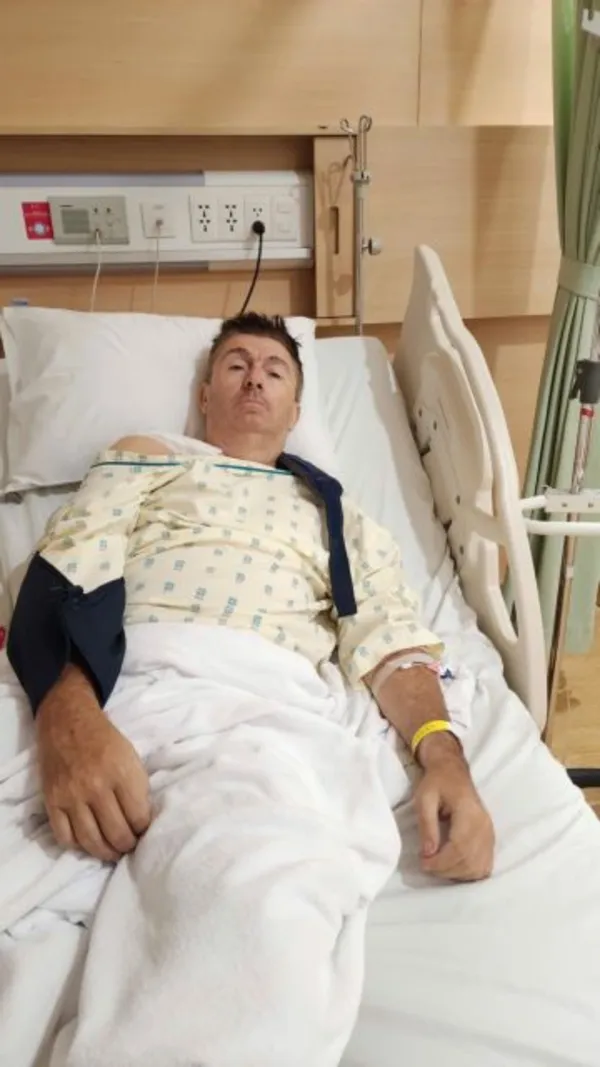
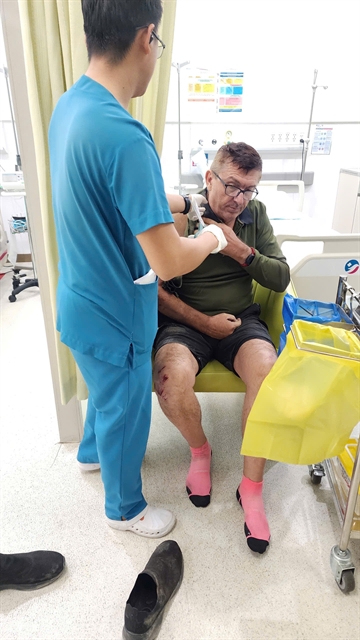
| Patient receiving treatment in the Emergency Department of District 2. VNS Photo Vu Thi Loan |
by Tony Kuschert*
With around 10,000 deaths – the majority involving motorbikes – in Việt Nam every year, it’s a fact that anyone using the roads faces the risk of being involved in an accident at some point. This is especially challenging for foreigners, as I discovered firsthand when I recently had a serious motorbike accident.
This is a lesson in the true risks foreigners face when riding motorbikes in Việt Nam. My accident happened in Đồng Nai Province, and although I can see Landmark 81 from my home, I quickly felt 1,000km from anywhere as I laid on a dirt road somewhere behind Nhơn Trạch, Đồng Nai.
The accident
I was riding home from work this past week. It was a very normal day, and I stopped at the supermarket to buy a few items. I live in the rural section of Nhơn Trạch, about 35km from the centre of HCM City. It’s a very rural setting with broken roads and tracks mixed with new highways and modern infrastructure.
After leaving the supermarket, I turned off the main road onto an old access road leading to my housing estate. This road is used by trucks and is in a constant state of disrepair. Potholes can be up to two metres wide and deeper than anything I’ve ever seen in Việt Nam.
Someone had dumped sandstone gravel into some of the holes in an effort to fix the road surface. Mixed into it were large rocks. At only 20km per hour, I hit one of these rocks at the same moment I braked sharply. The impact threw the front wheel to the left, and the bike disappeared from under me as I plummeted onto the broken, rocky road.
I landed heavily on my right side. I was unconscious for a short time. When I woke up, I knew immediately that I had significant injuries. I couldn’t move or stand.
A woman and a man stopped to help me. The woman took a photo of me, and the man did something – I’m still not sure what. And this became my first lesson. I tried speaking Vietnamese to them, but they didn’t listen. Within a minute, they got back on their motorbikes and rode off, leaving me lying helpless in the sandstone gravel with fuel leaking from my bike only a metre away.
A few minutes passed before another motorbike rode by. I shouted, “HELP – HELP!” and the man stopped. The next few minutes were a blur, but the end result was that the owner of a nearby workshop and his son – complete strangers – lifted me gently from the gravel.
Their hands were steady, careful, almost protective. They didn’t hesitate, didn’t question, didn’t look away from the mess I was in. They simply acted, not caring about the fact I was a foreigner.
They took me into their home, and in that moment, their small workshop felt like the safest place in the world. I sat helplessly in pain, confused, but they moved around me with a bustling urgency – taking my bike, gathering my belongings, making sure I wasn’t alone. Their kindness cut through the shock, giving me my first sense of hope after the crash.
Then I called my wife, who was only a few kilometres away. Time had no meaning in that state, but she eventually arrived. The moment I saw her face – worried, determined, but in a state of panic – I knew I wasn’t alone anymore.
Her presence grounded me, even as everything else felt chaotic. She spoke firmly to the people around us, trying to make sense of the situation, trying to protect me. I just needed to get to a hospital, and she became my anchor in that storm.
Getting to hospital
This is where things began to break down. There were no taxis and very few rideshare services in Nhơn Trạch. The workshop owner – a man who I had never met before – frantically called everyone he knew, pacing with his phone pressed to his ear, trying to find a way to get me help.
Even through the pain, I could feel his worry. He wasn’t just helping out of obligation; he genuinely cared. That sincerity, that human connection, is something I’ll never forget.
Ambulances were also not available. There are no major hospitals in the region, so calling an ambulance wasn’t an option. I felt further and further away from help.
Then I heard a truck engine rumble to life. The workshop owner, desperate to get me to safety, climbed into a massive 20-tonne, 12-wheel truck he had been repairing and drove it to the front. He opened the door and said, “Get in. I will take you to the hospital.”
The sight of that giant truck – and the man willing to drive it for me – hit me hard. Even through the fear and pain, I felt a surge of emotion. This wasn’t just help. This was someone going far beyond what anyone could expect. His determination to get me to safety is something I will carry with me forever.
Just as I was preparing to somehow climb into the truck, a car appeared from nowhere. My wife shouted, “Stop! There is a car here. Get in the car!” Relief washed over me. The timing was perfect, but unexpected, and I just let others control the situation.
And with that, we were off to the local hospital in Nhơn Trạch. But the ordeal was far from over. The 10-minute ride ended with me being carried into the Cấp Cứu (Emergency Department). I sat on a bed, and they took my blood pressure. It was low.
In the background, I heard chatter in Vietnamese. My wife turned to me and said they were refusing to accept me as a patient because I was a foreigner.
In pain, bleeding, and with broken bones, I made my way back to the car – and the driver was still there. He had waited, without complaint, without knowing how long it would take.
As we drove toward HCM City, he didn’t speak, didn’t ask for anything. He simply focused on getting me to safety. Every kilometre he drove felt like a gift. I never got to thank him properly, but his quiet generosity is something I will never forget.
Shock and fear were setting in. I told the driver to get on the highway and head toward HCM City. Our map apps lit up as we searched for the nearest hospital that would accept a foreigner.
I was confused, but I remembered the red and white sign of the American International Hospital in An Phú. I told the driver to take me there. I just needed to reach a hospital.
Every bump and crease in the road sent agony through my body. For 20 minutes, I sat in the back seat in pain and shock, praying to reach safety.
At hospital in HCM City
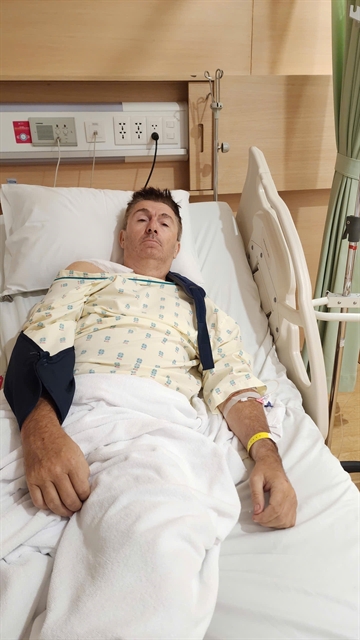 |
| Patient wakes at 1am after emergency surgery. Photo Vu Thi Loan |
Finally, we entered the hospital driveway, and I was taken into the emergency room. The moment the medical team surrounded me, I felt an overwhelming sense of relief.
Their calm voices, their steady hands, the way they moved with purpose – it felt like stepping out of chaos and into safety. For the first time since the accident, I felt protected. I felt seen. I felt like everything might actually be okay.
The rest of the story is straightforward. I arrived at around 6.30pm and went into surgery for my smashed collarbone at around 11pm. I was in the ward by 2am and felt stable.
The morning passed quickly, and by 1pm the next day, I was in a taxi heading home for a six-week recovery.
Reflecting on the experience
This story has many conundrums. The anger I felt being left on a dirt road with serious injuries made me rethink my overall safety in Việt Nam as a foreigner.
Then the 20-tonne truck pulling up brought a feeling of amazement – that a man would go so far out of his way to help me. I still get a tear in my eye thinking about how wonderful he and his family were to me and my wife.
That feeling quickly changed when I was rejected from the local hospital simply because I was a foreigner. I wasn’t angry – this is Việt Nam, and having lived through the COVID pandemic, I understand that life here is different, whether we understand it or not.
And the car driver, wherever he came from, gave up two hours of his day to get me to safety. I never spoke to him or got to thank him due to my condition, but he is another example of how amazing Vietnamese people can be.
In the hospital, I felt safe. The system worked, and I was helped. In the end, I received a plate and seven pins in my collarbone, and the other injuries to my ribs, leg and arm were treated by the lovely doctors and nurses.
But this story is about my vulnerability as a foreigner in Việt Nam. In the cities, there is a sense of certainty, to a point, that help is available in an emergency. A variety of international clinics and hospitals across HCM City means residents are never far from care.
But for the many foreigners living outside major cities, this example shows how a simple motorbike accident, even with significant injuries, can become incredibly complex because systems in rural areas and hospitals are not set up to support non-citizens.
As I said, I wasn’t angry. This is a system that has developed over generations. It allows factory workers and poorer communities access to medical services in rural areas. But it can be a shock when an emergency involves a foreigner.
There is no perfect solution. I suppose you should always know your closest hospital if you’re a rural or regional expat in Việt Nam. And as you travel, make note of hospitals that will assist foreigners in emergencies.
The final point is not about what happened, but what could have happened. Thankfully, when I moved out of HCM City to this rural area, I bought a full-face helmet with a visor. The impact marks on the helmet show clearly that buying this high-quality helmet may have saved my life.
Sitting on my balcony overlooking the Sài Gòn River, I struggle to move and feel uncomfortable as my body recovers. But I’m also smiling because when I needed help the most, so many wonderful Vietnamese people stepped forward.
Their kindness wasn’t small. It wasn’t polite. It was powerful, human and deeply moving. They carried me, literally and emotionally, through one of the more frightening experiences of my life. I will forever be grateful for them.
Việt Nam is full of complexity. It has amazing people, strange rules and some bizarre responses to the obvious. And as a foreigner, that can bring a sense of discomfort, which is a reminder that sometimes we can feel very alone in this densely populated country.
But it hasn’t changed my love for this place. If anything, it has strengthened my appreciation for my community and the people who showed me kindness and support beyond anything I could imagine. I sit on my balcony and smile, grateful for the wonderful people who helped me through this experience, my first major accident in Việt Nam.
Travel safe, and wear a proper helmet. — VNS
* Tony Kuschert is a freelancer, teacher and YouTuber living in the south of Việt Nam since 2013.
Read original story on Vietnam News