


As 2026 begins, sourcing from Vietnam should no longer be seen as a temporary solution or a short-term hedge against China-related risks. For many international buyers, Vietnam has become a long-term manufacturing base, requiring disciplined planning, realistic expectations, and clear operational strategies.
The biggest shift isn’t Vietnam’s ability to manufacture, but the expectations on buyers themselves. Factories are now more experienced and selective, logistics have normalized compared to pandemic years, and compliance requirements are more strictly enforced. Success depends less on “discovering Vietnam” and more on learning to operate effectively in a mature sourcing market.
This article is written for 2026, aiming to explain how sourcing from Vietnam really works today. A US-focused case study is included to illustrate common patterns, risks, and decision points, but it’s not a formula to copy.
Vietnam Manufacturing in 2026: Competitive but No Longer “Easy”
Vietnam’s manufacturing sector is more mature than during the early China+1 transition period. Export-oriented factories are better equipped, management teams understand international buyer expectations, and quality systems have improved significantly across furniture, textiles, home décor, and light industrial assembly.
However, maturity comes with trade-offs. Labor costs continue to rise, industrial zones are near full capacity, and well-run factories are increasingly selective about clients. Buyers with unclear specifications, inconsistent communication, or unrealistic volume expectations often struggle.
Vietnam remains particularly strong in outdoor and patio furniture, textiles, and home & garden products. In many categories, competition is now based on reliability, flexibility, and scalability, not just price.
Reference Case Study: One Example Among Many
To illustrate, consider a real-life sourcing project for outdoor furniture exported to the US in 2025–2026.
This example highlights common conditions: factory selection dynamics, container-level pricing, and logistics constraints.
It is not a blueprint for success, but a reference showing how decisions around supplier validation, packaging, and freight coordination affect outcomes. Results vary depending on product category, order volume, and buyer preparation.
Finding Suppliers: Research Matters More Than Platforms
While most buyers start their sourcing journey online, experienced importers rarely rely on digital platforms alone.
Effective supplier discovery now combines desk research with in-person engagement at trade events such as the Global Sourcing Fair, Lifestyle International Fair, or specialized industry shows like the Vietnam International Trade Fair for Apparel, Textiles, and Textile Technologies (VIATT).
Trade shows remain valuable not just for sales, but also for assessing factory capabilities, understanding their client base, and connecting directly with decision-makers. As competition for production capacity grows, identifying suppliers who are truly suitable for long-term cooperation is far more important than simply finding many options.
RFQs, Samples, and Factory Audits: Risks Become Visible
The RFQ and sampling stage is often decisive. Price differences between shortlisted factories are usually small; real differentiators are communication quality, responsiveness, and ability to anticipate export-related issues.
Factory audits in 2026 focus less on certifications and more on operational realities: production flow, quality checkpoints, packaging, and shipping experience. For furniture and bulky goods, container loading and packaging can be as important as product design.
Rushing this stage often leads to problems later, when correcting mistakes becomes costly or impossible.
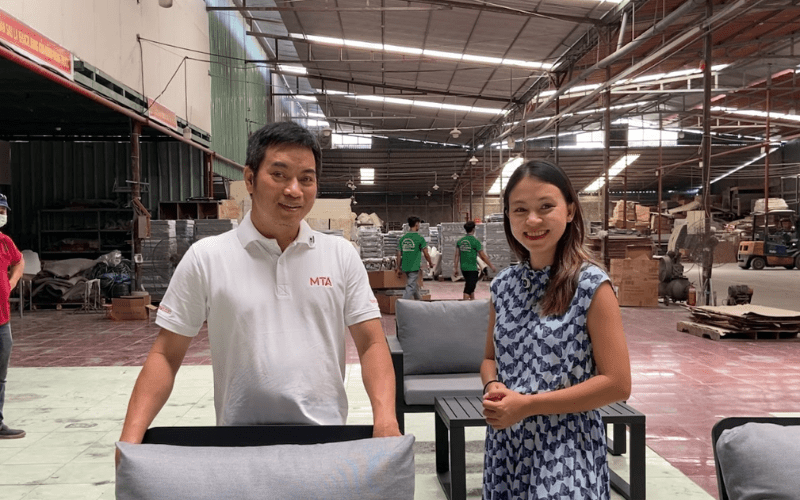
A sourcing agency auditing factories in Vietnam on behalf of international buyers to ensure quality and compliance.
>> Related Article: Sourcing from Vietnam: From Online Dropshipping to Container Shipping
Production Planning, MOQs, and Container Economics
Factories typically price based on container-level economics rather than individual SKUs. Minimum order quantities increasingly reflect full container utilization, tighter margins, and higher operating costs. Buyers must plan assortment, packaging, and volume together. Lead times usually range from 45–60 days, plus time for quality inspections and export prep.
Vietnam rewards scale and planning. Fragmented, low-volume “test” orders may face higher unit costs and weaker factory commitment, even when product quality is fine.
Import Costs and Logistics: More Stable, Less Room for Error
Import costs from Vietnam are more transparent than during the pandemic, but remain sensitive to freight fluctuations and destination-side charges. Product cost is usually the largest share of landed cost, followed by ocean freight and port fees.
Furniture and home goods from Vietnam benefit from relatively stable tariff treatment versus China-origin products. However, rising inland transport and warehousing costs mean final margins are shaped by post-arrival logistics decisions, not factory price alone.
For buyers, sourcing, logistics, and inventory planning must be managed as a single integrated system.

>> Related article: The Complete 2026 Guide to Outsourcing Manufacturing in Vietnam for Global Companies
Customs Clearance: Procedural but Unforgiving
Customs are often invisible but unforgiving. In 2026, strict scrutiny on valuation, HS codes, and origin documentation makes consistency essential.
Experienced importers work with licensed customs brokers and Vietnam-side freight partners. Even minor discrepancies can trigger inspections, delays, or extra costs. Treating customs as an afterthought is a common and costly mistake.
Why First-Time Buyers Often Struggle
Many sourcing failures stem not from factory limitations, but from misaligned expectations.
Factories are busy, export-driven, and selective. Buyers who approach sourcing casually, treat inquiries as price checks, or change specifications mid-process are often deprioritized. Communication slows, timelines slip, and momentum disappears.
Other challenges come from container economics. Focusing solely on unit price while ignoring packaging, SKU mix, and loading efficiency can quickly erode perceived savings. Quality issues often arise not from factory incapability, but from misaligned expectations. Sample approval alone doesn’t guarantee consistent production.
Finally, customs clearance remains a hidden risk, especially for newcomers unfamiliar with international procedures.
Final Observations
Sourcing from Vietnam in 2026 is neither experimental nor easy. Vietnam has firmly established itself as a core manufacturing hub for furniture, textiles, and home & garden products.
The market favors buyers who are prepared, clear in their communication, and have long-term intent. Success belongs to those who understand Vietnam’s maturity, respect its constraints, and develop sourcing strategies grounded in operational reality rather than outdated assumptions.
Related
Discover more from Vietnam Insider
Subscribe to get the latest posts sent to your email.
Source: Vietnam Insider