

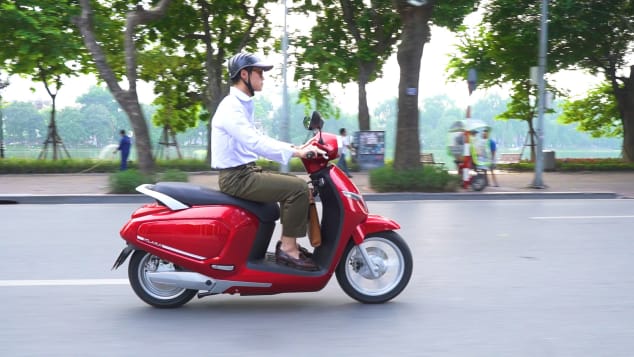
A growing number of apartment complexes in Hanoi are refusing to accept electric motorbikes, triggering a fierce debate among residents and exposing the city’s infrastructure gaps as Vietnam transitions toward cleaner transport.
At HH Linh Đàm — one of the capital’s largest residential clusters — families like that of Kiều Oanh have been scrambling to find parking after the building management announced it would stop registering new electric vehicles from 1 December and ban them entirely from underground garages starting February 2026.
EV Owners Feel Betrayed by “Green Mobility” Policies
Oanh sold her gasoline motorbike earlier this year and switched to an electric one, encouraged by both lower running costs and the city’s plan to restrict gasoline motorcycles inside Ring Road 1 by mid-2026.
“I tried to do the right thing and go green,” she said. “Now I have a vehicle I can’t park anywhere. If I sell it, I lose money. If I keep it, I have nowhere to charge it.”
Nearby parking lots have refused to take EVs, and the few that do are too far away.
Thousands of HH Linh Đàm residents who use electric motorbikes are facing the same dilemma, arguing that the new building rules contradict Vietnam’s push to reduce emissions and pollution.
Gasoline Riders Support the Ban Over Fire Concerns
Not everyone opposes the restrictions. Some petrol-motorbike owners say the building’s parking structure, built before 2014, lacks EV-ready infrastructure and proper safety systems.
“The basement is already overcrowded, and the fire prevention system is basic,” said resident Thu Thảo, 30. “A lithium battery fire in an enclosed space could be catastrophic.”
The conflict has created two opposing camps in resident groups, with arguments intensifying over safety, environmental goals, and property rights.
Authorities Step In: Buildings Cannot Ban EVs
On 4 December, the Hoàng Liệt Ward People’s Committee intervened, ordering the building management to stop refusing EV parking. The ward cited the 2023 Housing Law, which recognizes electric motorbikes as legal vehicles and stresses that no scientific evidence proves they are more fire-prone than gasoline bikes.
Instead of a blanket ban, authorities instructed the building to:
• designate a separate charging area
• upgrade fire prevention equipment
• implement monitoring and supervision
The directive reflects a broader challenge across Hanoi: apartment infrastructure has not kept pace with the rapid rise of electric motorbikes.
A Capital-Wide Pattern of EV Rejections
HH Linh Đàm is not alone. On 2 December, an apartment complex in Long Biên District also stopped accepting EVs, saying the number had doubled beyond its planned capacity and that it lacked fire suppression systems suitable for lithium-ion batteries.
Residents in Văn Khê (Hà Đông) similarly reported being discouraged from parking EVs even when spaces were available.
The concern is mirrored in public sentiment. A survey of 2,500 VnExpress readers found:
• 48% of EV users felt discriminated against
• 42% faced obstacles when charging
• 6% were outright refused parking
Another poll of 13,000 respondents showed that if Hanoi bans gasoline motorbikes, only 24% would switch to EVs. Most would turn to public transport or ride-hailing instead — a sign that infrastructure and safety perceptions remain major barriers.
Experts: The Problem Is Infrastructure, Not EVs
Associate Professor Đỗ Văn Dũng of the Ho Chi Minh City Automobile and Engine Association says the fear surrounding EVs stems from inadequate charging facilities and concerns over low-quality, unregulated batteries.
For older apartment complexes with limited underground space, he recommends outdoor, sheltered EV parking zones equipped with thermal sensors. Long-term, he says Vietnam should explore battery-swap systems, which are widely used in Taiwan and China and reduce fire risks associated with on-site charging.
A Temporary Truce at HH Linh Đàm
Following government instructions, local leaders at HH Linh Đàm say they are planning a compromise: a dedicated EV parking area in the outdoor courtyard, with a roof and round-the-clock security — a solution intended to balance safety and residents’ mobility needs.
The debate highlights a fundamental tension in Vietnam’s green transition: Hanoi is encouraging citizens to adopt electric vehicles, yet many residential buildings lack the infrastructure to support them. Until that gap closes, more conflicts like Linh Đàm’s are likely to emerge.
Related
Discover more from Vietnam Insider
Subscribe to get the latest posts sent to your email.
Source: Vietnam Insider