

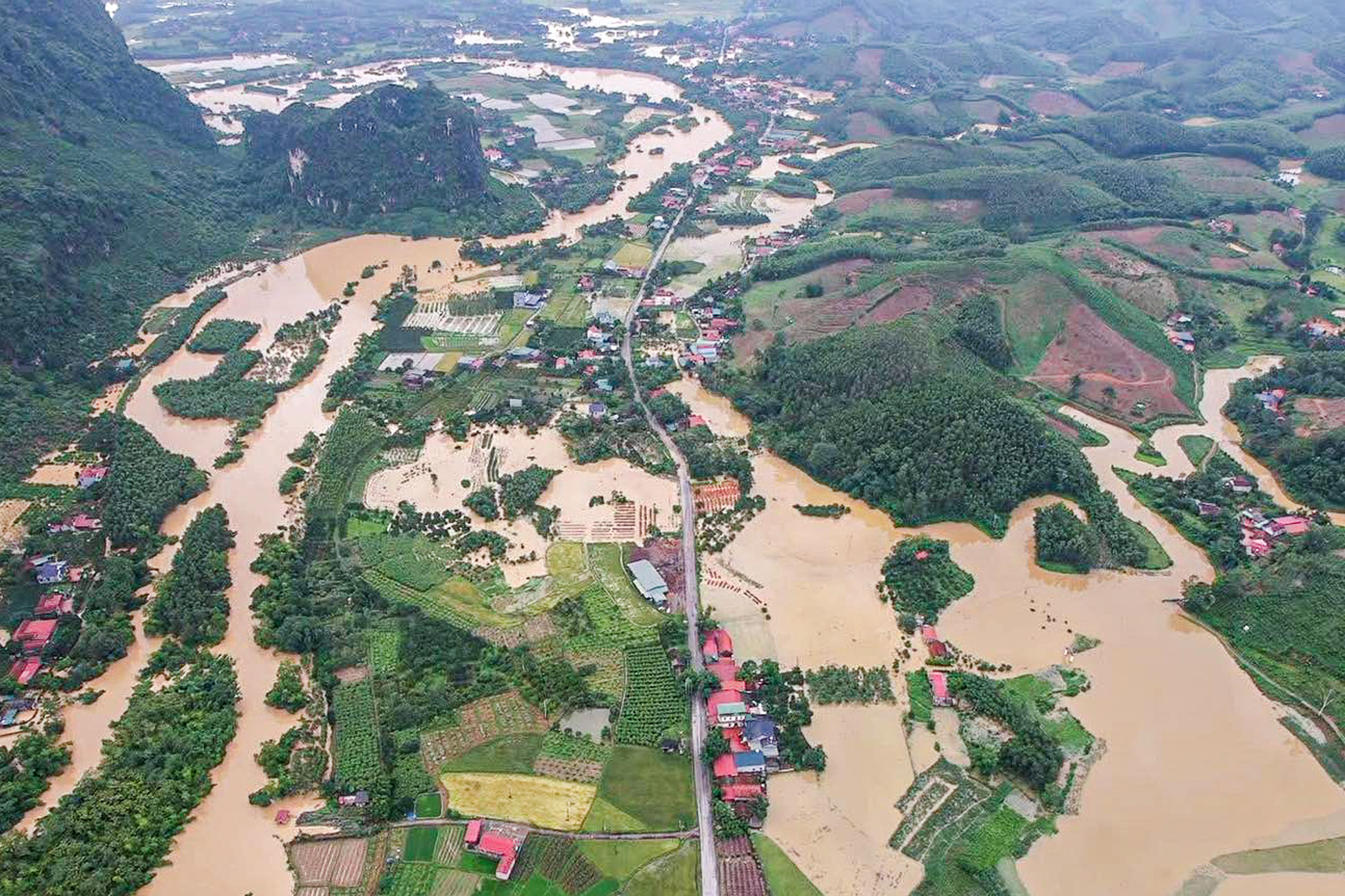
Vietnam has suffered severe and unusual natural disasters since the start of 2025, leaving 409 people dead or missing and causing economic losses estimated at more than VND85 trillion (US$3.4 billion), according to the Department of Dyke Management and Disaster Prevention.
Speaking at a forum on disaster forecasting and early warning on Nov. 25, officials said the country has endured a year of back-to-back storms, floods and extreme rainfall affecting wide areas.
Authorities report 727 injuries, more than 337,000 homes damaged or destroyed, and extensive losses to agriculture, including nearly 553,500 hectares of rice and crops and 376,800 hectares of other plantations inundated.
Vietnam has experienced 19 storms and tropical depressions in the East Sea this year, just one fewer than the record in 2017. Another system near the Philippines is likely to strengthen into the fifteenth storm of the year as it moves into the East Sea.
Extreme rainfall pushed 13 rivers in northern and central provinces past historic flood levels, inundating cities and low-lying areas from Hanoi and Bac Ninh to Thanh Hoa, Nghe An, Quang Tri, Hue, Da Nang, Gia Lai and Dak Lak.
Several regions suffered overlapping disasters including storms, successive floods, flash floods and landslides, especially in northern mountainous provinces and the central region, threatening dams, transport routes, infrastructure and lives.
The Nov. 16–20 floods in central Vietnam alone left 102 people dead or missing, submerged more than 200,900 homes, caused landslides at 119 locations, and damaged over 82,100 hectares of rice and crops. Initial losses are estimated at VND13.248 trillion.
Officials warn that central Vietnam faces further flood risks in the final months of 2025, with the current tropical depression near the Philippines expected to bring heavy rain to the south-central coast.
Authorities urged provinces to use periods of good weather to repair damage and prepare for the next wave of disasters.
The Ministry of Agriculture and Environment said upcoming work will focus on improving forecasting and early-warning systems, expanding rain-monitoring networks, and developing village-level risk maps. Provinces are instructed to relocate residents from high-risk zones and adjust farming practices to better adapt to natural conditions.
Vietnam will continue upgrading dykes, reservoirs and flood-control systems while enhancing communications, applying new technology and expanding international cooperation to strengthen long-term resilience as climate-related disasters become increasingly severe.
Related
Source: Vietnam Insider