

Contributed by Virtus Prosperity
After a prolonged slump, Southern Vietnam’s real estate market—centered on Ho Chi Minh City (HCMC) and its satellite provinces—is primed for a major surge, attracting capital flows redirected from the overheated Northern market.
Driven by a government mandate for GDP growth, massive public infrastructure spending, and the failure of low bank interest rates to compete with soaring inflation and gold prices, investors are pivoting to property as the primary asset for wealth preservation and growth.
For international business leaders and fund managers, the South is emerging as the country’s next high-return frontier. The key insight: Hanoi’s condominium prices surged by since early 2023, reaching unsustainable levels (nearly all units now over $2,350 per square meter), making the South, with its untapped land values and pipeline of major new infrastructure, the compelling next stop for investment capital. The coming year, 2025, is now widely viewed as the hinge point for this crucial market reversal.
Macro Forces: The Trio Pushing Money Out of Savings and Into Property
The shift in real estate capital is a direct result of three interlocking macroeconomic pressures in Vietnam:
- High Inflation and Currency Volatility: Vietnam’s financial market is showing clear signs of instability. Domestic gold prices have soared by approximately , reflecting a global flight to safe-haven assets amidst geopolitical uncertainty. Simultaneously, the VND/USD exchange rate has climbed nearly on the free market, signaling mounting pressure on the Vietnamese Dong.
- Unattractive Interest Rates: With global rate cuts looming and local 12-month deposit rates at most commercial banks holding stubbornly below per year, keeping cash in savings accounts is a guaranteed loss of value. This forces capital to seek alternatives.
- Government-Led Growth Focus: Despite global headwinds, the Vietnamese government is aggressively pushing its GDP growth target for 2025, primarily through a massive increase in public investment. This capital injection is channeled directly into large-scale national infrastructure, which immediately translates into higher land values in the areas it connects.
This combination has made real estate—and specifically, the undervalued South—the most logical destination for high-net-worth capital seeking superior returns.
</p>
<p> ” data-medium-file=”https://i0.wp.com/vietnaminsiders.com/wp-content/uploads/2020/05/Saigon-Ho-Chi-Minh-City.jpg?fit=300%2C200&ssl=1″ data-large-file=”https://i0.wp.com/vietnaminsiders.com/wp-content/uploads/2020/05/Saigon-Ho-Chi-Minh-City.jpg?fit=749%2C500&ssl=1″ class=”size-full wp-image-37640″ src=”https://vietnamstar.net/wp-content/uploads/2025/10/vietnams-next-property-hotspot-why-investors-are-dumping-hanoi-for-the-180b-south.jpg” alt width=”749″ height=”500″ srcset=”https://vietnamstar.net/wp-content/uploads/2025/10/vietnams-next-property-hotspot-why-investors-are-dumping-hanoi-for-the-180b-south.jpg 749w, https://vietnamstar.net/wp-content/uploads/2025/10/vietnams-next-property-hotspot-why-investors-are-dumping-hanoi-for-the-180b-south-1.jpg 300w, https://vietnamstar.net/wp-content/uploads/2025/10/vietnams-next-property-hotspot-why-investors-are-dumping-hanoi-for-the-180b-south-2.jpg 585w, https://i0.wp.com/vietnaminsiders.com/wp-content/uploads/2020/05/Saigon-Ho-Chi-Minh-City.jpg?resize=263%2C175&ssl=1 263w” sizes=”auto, (max-width: 749px) 100vw, 749px”></p>
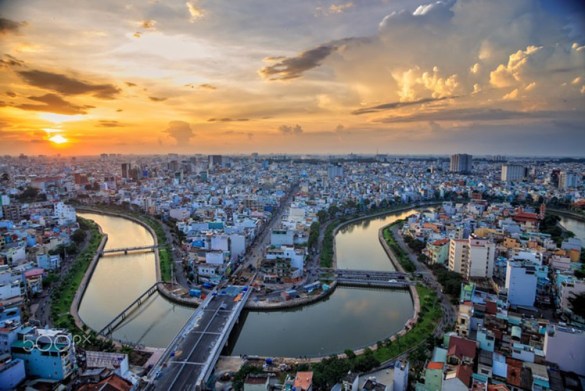
<p id=) A meander of Saigon river situated in the heart of Ho Chi Minh City. (Photo: Frida Engstroem / 500px.com)
A meander of Saigon river situated in the heart of Ho Chi Minh City. (Photo: Frida Engstroem / 500px.com)
The North-to-South Pivot: Why Hanoi’s Boom Became the South’s Opportunity
The Southern market’s appeal is amplified by the exhaustion of the Northern market’s price growth:
- Hanoi’s Price Saturation: Between 2021 and 2025, Hanoi witnessed a staggering price increase in real estate, with its condominium prices nearly doubling since Q1 2023. This explosive growth has peaked, leaving limited potential for short-term profit margins.
- The South’s Value Proposition: In the same period, Ho Chi Minh City’s market recorded a more moderate increase. This lower, more sustainable growth curve means that land and property in HCMC and its surrounding provinces (Binh Duong, Dong Nai, Long An) still offer a significantly lower base price and therefore higher future profit potential.
This profit-driven calculation is the single biggest driver of the North-to-South capital migration.
Infrastructure Revolution: The New Arteries for Investment Flow
The true catalyst for the South’s revival is its unprecedented infrastructure pipeline, which is transforming the region from a water-dependent transport network into a modern logistics hub centered on HCMC.
The area is now one massive construction site, with projects designed to link the economic powerhouses of the Southeast region:
- Ring Roads and Expressways: Key projects like Ring Roads 3 and 4 (HCMC) and the Ben Luc – Long Thanh, Bien Hoa – Vung Tau expressways are being fast-tracked. These directly connect HCMC with the manufacturing and port hubs of Long An, Dong Nai, and Ba Ria – Vung Tau.
- The Long Thanh Airport Nexus: These expressways are strategically designed to feed into the Long Thanh International Airport project, which is set to become one of Southeast Asia’s largest aviation hubs.
- Western & Mekong Connectivity: New expressways toward Moc Bai (Tay Ninh) and the planned HCMC – Soc Trang route will finally integrate the Mekong Delta with HCMC’s economic core, unlocking vast new development potential.
Investment focus is therefore hyper-local, targeting areas like Thu Duc City (former District 9), Dong Nai, and Ba Ria – Vung Tau—locations along these new infrastructure corridors that boast strategic positioning and low historical valuations.
The Outlook: Foreign Direct Investment (FDI), attracted by Vietnam’s stable political environment and new trade agreements, is expected to further fuel this Southern surge. For international investors, successful ventures will hinge on selecting projects with clear legal status and proximity to these infrastructure bottlenecks, where the government’s spending commitment guarantees future appreciation.
Related
Discover more from Vietnam Insider
Subscribe to get the latest posts sent to your email.
Source: Vietnam Insider