

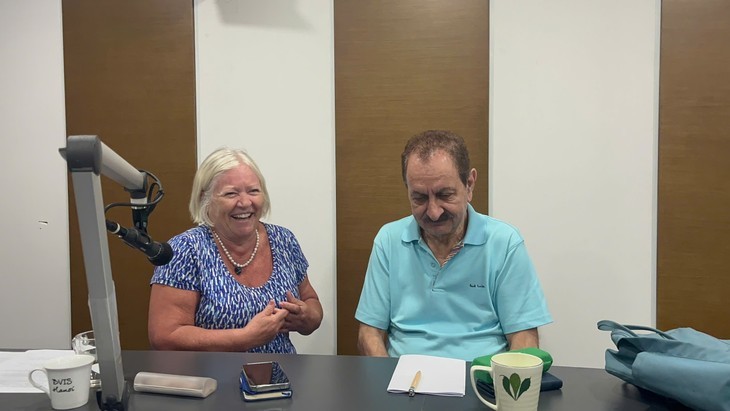
Over decades and across continents, Elisabeth Dahlin and her husband Andreas have maintained a profound and unwavering connection with Vietnam—a country they both consider their second home.
A Journey Rooted in Solidarity
Elisabeth’s bond with Vietnam began in the early 1970s, when as a teenager in Lapland, northern Sweden, she joined anti-war protests in solidarity with the Vietnamese people. Deeply influenced by the image of Swedish Education Minister Olof Palme marching against the war, she, along with her family, joined millions of Swedes who opposed the bombings in Vietnam. “It was bitterly cold, and there was snow everywhere,” she recalled. “But my sister, my parents, my teachers, and I were all out collecting signatures. In a country of 8 million, 2.7 million signed the petition.”
Those early experiences laid the foundation for a lifelong connection. “We saw the devastating images of war on TV—especially the famous photo of the napalm girl—and they left a mark on an entire generation across Europe,” Elisabeth said.
First Steps in Vietnam
Motivated by her passion for justice and peace, Elisabeth first arrived in Hanoi in December 1979 as part of a youth delegation invited by the Ho Chi Minh Communist Youth Union. Just 21 years old at the time, she had been studying Vietnamese in Stockholm under a special Swedish government program. That journey marked the beginning of a deep, personal immersion into Vietnamese language, culture, and society.
Her husband Andreas followed shortly after in 1980. “I came for love,” he said with a smile. While Elisabeth continued her studies, Andreas took a job with the Swedish International Development Cooperation Agency (SIDA), helping manage the Swedish experts’ camp in Hanoi and facilitating medical supply distribution for the Swedish-funded hospital in Uong Bi.
Living and Working with the Vietnamese People
From 1980 to 2001, the couple spent over eight years in Vietnam. Elisabeth held various positions, including working at the Vietnam-Sweden Hospital and later with the Swedish Embassy in Hanoi. She also returned multiple times in advisory roles on Vietnam’s WTO accession and child rights advocacy. Fluent in Vietnamese, she frequently sang Vietnamese folk songs—her favorite being the iconic “Mùa xuân trên thành phố Hồ Chí Minh,” which she performed at the 10th anniversary of reunification in 1985.
Her love for Vietnam also extended to its rich musical heritage. Elisabeth developed a fondness for Quan họ folk songs from Bắc Ninh and still fondly recalls tunes like “Bèo dạt mây trôi” and “Trống cơm.”
A Relationship That Transcends Generations
Elisabeth and Andreas’s bond with Vietnam has not only endured—it has been passed down to their children. “Our daughter was just three when we moved here. She picked up her first Vietnamese folk song within weeks,” Elisabeth shared. “Today, she cooks phở twice a week, and her only request from us is to bring back Vietnamese spices and phởseasoning.”
The Dahlin children grew up immersed in Vietnamese culture, language, and friendships. “For them,” Andreas noted, “Vietnam is part of their upbringing. It’s not just our story—it’s theirs, too.”
Witnessing Vietnam’s Transformation
Having lived through multiple eras in Vietnam—from the post-war 1980s to the reform era of the late 1990s and the vibrant present—the couple has seen the country evolve firsthand. “Back in the 80s, tourism was virtually non-existent,” Andreas said. “But when we returned in 1997, things had changed. And now, Vietnam is thriving—tourism is booming, travel is easy, and so many Swedes are coming here.”
For those who’ve never visited, the Dahlins always recommend Vietnam’s stunning beaches, rich cuisine, and profound cultural history. “Swedes love sunshine, great food, and meaningful travel experiences—Vietnam offers all of that,” Andreas added.
A Return Marking a Historic Celebration
In 2025, Elisabeth and Andreas returned to Vietnam once again, this time to mark the 50th anniversary of the country’s reunification. The occasion was highlighted by Sweden’s gift of a commemorative documentary film Victory Vietnam, directed by Swedish filmmaker Bo Öhlén.
Speaking to VOV during the visit, Elisabeth reflected: “This is not just a celebration of Vietnam’s progress, but a celebration of friendship—a deep, enduring connection between our two nations and our people.”
From snowy Swedish streets collecting signatures to tropical Vietnamese cities filled with song, Elisabeth and Andreas Dahlin’s journey illustrates a remarkable cross-cultural bond. Their story is a testament to the power of empathy, understanding, and the lasting ties that grow from shared dreams of peace and friendship.
Related
Discover more from Vietnam Insider
Subscribe to get the latest posts sent to your email.
Source: Vietnam Insider