

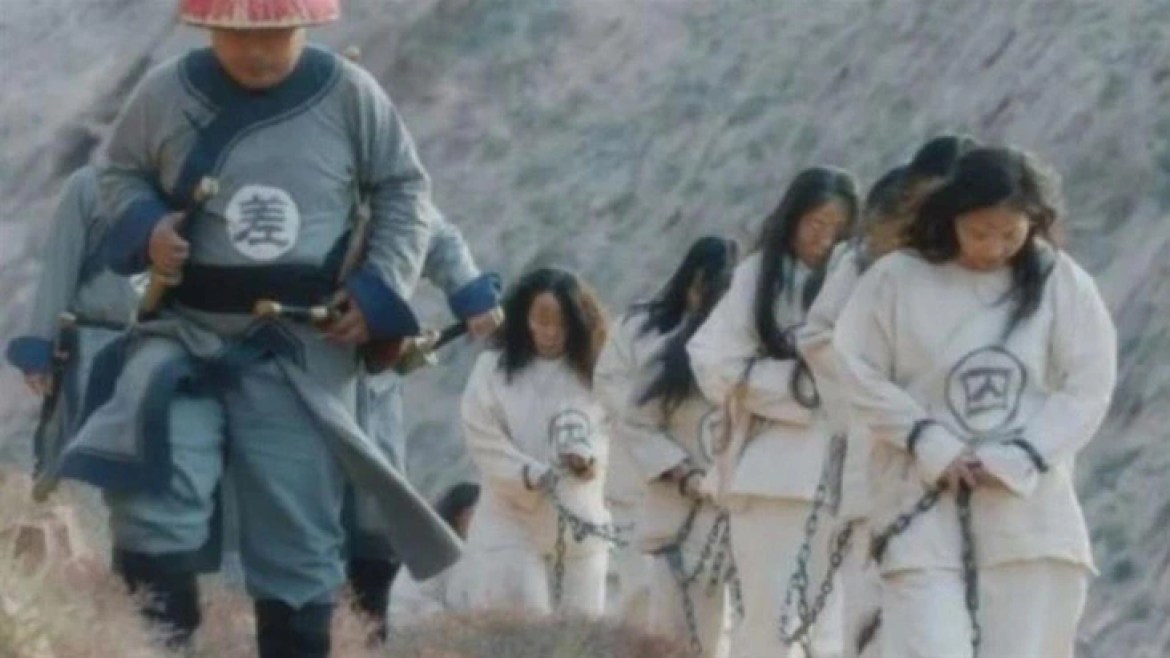
The idea of this tour is to combine sightseeing with a form of “situational acting and audience interaction” based on the situations in the TV series Empresses in the Palace to give visitors an immersive experience. The souvenirs are also quite unique, with pink shackles, leg chains and clothes printed with the word “Prison”.
On October 15, Kinh Bac Ho Tourism Group also posted a short video promoting this project.
On October 31, Sina contacted the management board of Kinh Bac Ho tourist area to learn about the progress of the project. The operator said that they have not received any notice about the implementation. Everything is just at the planning stage, there is no specific announcement about the method and time of implementation. The tourist area has not yet started to build any related facilities.
“We have not received any notification at this time, so we cannot provide further information,” the employee said.
Ninh Co Thap in history
Ninggu Pagoda is not a tower, but the old name of the city of Ning’an (Heilongjiang). During the Qing Dynasty, Ninggu Pagoda was a place of exile for criminals, a harsh land. Ninggu Pagoda became widely known thanks to the movie Empresses in the Palace starring Sun Li, in which the emperor exiled Zhen Huan’s father and his family to Ninggu Pagoda. This scene became a major turning point in the relationship between the two.
In history, being exiled to Ninggu Tower was not fun at all, but could actually be life-threatening. Many famous people were exiled here, including Zheng Chenggong’s father Zheng Zhilong, the family of the great writer Jin Shengtan, the family of the thinker Lu Liuliang, the family of Fang Gongqian and Fang Xiaoxiao (Anhui), the father and son Yang Yue and Yang Xin (Zhejiang), the famous poet Wu Zhaoqian, the Buddhist scholar Han Ke, the writer Zhang Jinyan, etc.

A photo captures the moment depicting prisoners being exiled to Ninggu Tower during the Qing Dynasty – Photo: Weibo
Among those exiled to Ninh Co Thap, Ngo Trieu Khien was the one who lived in this land for 22 years. Through Ngo Trieu Khien’s poems, later generations learned about the real life of those exiled in Ninh Co Thap.
In the 18th year of Shunzhi (1661), in a letter to his parents, Wu Zhaoqian wrote: “Ninggu is the coldest and most miserable place in the world. From early spring to mid-April, the wind is as strong as thunder, and even the smallest details cannot be seen. From May to July, it rains continuously. By mid-August, there is heavy snow. In early September, the river freezes. The snow freezes as soon as it falls to the ground. Looking a thousand miles away, all you can see is white snow.”
The most terrifying thing about being exiled to Ninggu Pagoda was the arduous journey. According to the monograph History of the Northeast Exiles , the number of people exiled to the Northeast during the Qing Dynasty was over 1.5 million. Due to the remote location of Ninggu Pagoda, those exiled halfway through were eaten by tigers and wolves, and taken away by apes…
After arriving at Ning Gu Tower, life became easier. Among the exiles from the Central Plains, many were literati and officials, gradually forming a culture of exile in the Northeast.
During the Qing Dynasty, many literati and scholars were exiled to Ningguta for literary crimes. Among them, there were countless wrongful convictions, and many of the exiles were victims of political infighting and were harmed by enemies. Countless people died on the way to Ningguta. The history of exile to Ningguta and the Northeast is not a story with a happy or interesting ending.
Controversial exile tour project
Although the project has not been officially launched, it has attracted widespread attention and debate online. On the discussion forum of the Heilongjiang Provincial Department of Culture and Tourism, some netizens expressed their interest: “In the past, prisoners who were exiled to Ninggu Tower probably never dreamed that today there would be people spending money to experience this.” They also expressed their desire to experience it, saying that this idea is very novel and attractive.
However, the project has also received much criticism, saying that turning the historical pain of Ninh Co Thap into entertainment is too superficial. The implementation of this project is not beneficial to helping tourists understand history but goes against the original purpose of cultural tourism.
In response to criticism, many netizens objected: “It’s just a tourism project, is there a need to make such a big deal out of it?”, “If you find it inappropriate, don’t go, why make a fuss?”.

Although not officially launched, the exile tour project in Ninh Co Thap has attracted widespread attention and debate online – Photo: Sohu
In recent years, immersive tourism has become very popular in China. Combining popular TV dramas and entertainment programs with local culture to create tourism projects has become more popular. For example, on the occasion of China’s National Day this year, Jiangsu Botanical Garden combined with the TV series Lianhualou to create a jianghu-style immersive tourism project, which received much praise from fans of the series.
However, there are also many immersive tourism projects that have been criticized as offensive. For example, a tourist area in Ha Nam allowed visitors to experience pretending to be Japanese soldiers, which was considered to have crossed the line.
Heilongjiang has rich tourism resources, including snowy mountains, forests and many majestic and beautiful sceneries.
Many experts believe that if Kinh Bac Ho Tourism Group wants to exploit this exile tour , instead of turning the suffering of the ancients into a trick to attract customers, it should deeply exploit the exile culture, arousing the true cultural and historical values of Ninh Co Thap – the political and military center of the northeastern border during the Qing Dynasty.
Currently, the Ninh Co Thap exile tour project has not been officially implemented yet, the final result still has to wait for the managers to consider.
Source: tuoitre.vn (Little moon)
Source: Vietnam Insider