

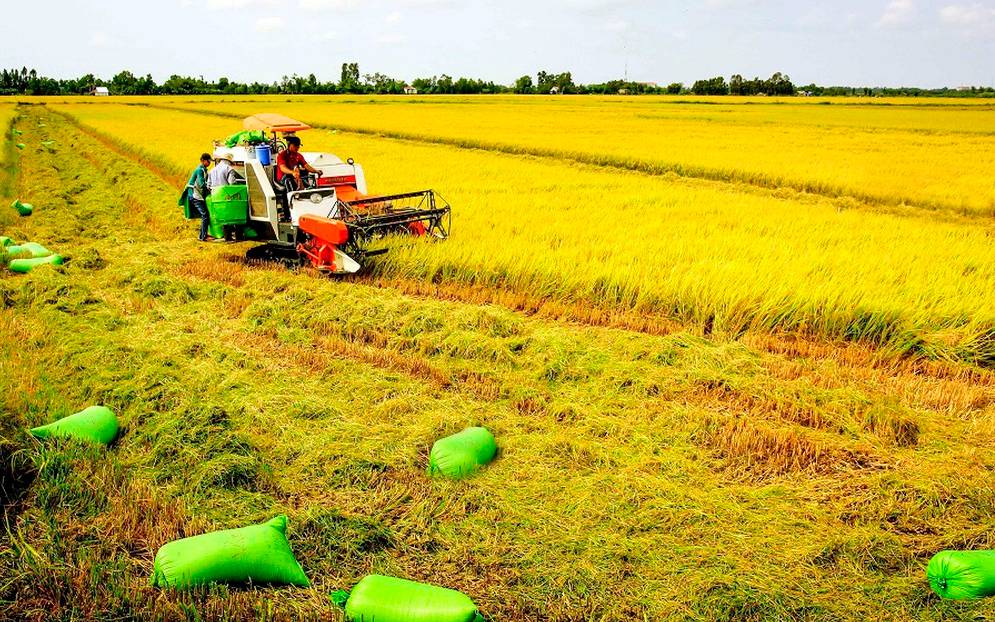

Rice transactions in Vietnam’s Mekong Delta have stalled after the Philippines, the country’s largest buyer, suspended imports for 60 days starting September 1.
The Philippines typically accounts for over 40% of Vietnam’s total rice exports. The sudden pause has left traders and exporters hesitant to stockpile, fearing falling prices and weak demand.
“Previously, I could buy up to 100 tons a day, but now I only dare to purchase a few tons for domestic sales,” said Ms. Hang, a trader in An Giang Province. Export contracts, she added, are on hold.
Exporters share similar caution. “Even though purchase prices are relatively low, we’re not stockpiling. We’re only buying enough for immediate needs,” said Nguyen Chi Thanh, director of Angimex’s rice division.
Prices Flat, Competition Rising
On September 8, raw and processed rice prices remained unchanged: IR 50404 at VND 8,500–8,600 per kilo, OM 5451 at VND 7,700–7,900, and OM 18 around VND 9,600–9,700. Premium varieties like Thai fragrant rice and Huong Lai continued to retail at VND 20,000–22,000 per kilo.
On the international market, Vietnam’s 5% broken rice is offered at USD 399 per ton—higher than Thai and Indian rice of the same grade. This price gap adds competitive pressure as buyers turn to cheaper alternatives amid softening demand.
Export Hubs Under Strain
In Vinh Long Province, where many firms export to the Philippines, operations are directly impacted. The provincial Department of Industry and Trade has urged local businesses to stay cautious, avoid panic buying, and diversify export markets to reduce risks. Companies were also encouraged to buy and temporarily stockpile rice to stabilize farmer incomes.
Wider Market Outlook
Between January and August, Vietnam exported 6.3 million tons of rice worth USD 3.17 billion. While volumes rose slightly, revenue fell nearly 18% due to lower average prices. The Philippines purchased 2.6 million tons, remaining Vietnam’s top customer.
The Ministry of Industry and Trade has warned exporters against over-reliance on a single market and stressed the need to expand into China, Indonesia, Malaysia, Africa, and the Middle East. The ministry also urged more long-term contracts, official trade routes, and improvements in quality and traceability to meet stricter import requirements.
Industry experts say Vietnam’s higher prices compared to Thailand and India reduce its competitive edge but do not erase its market share. “Major buyers still value Vietnam for its reliable quality and delivery,” one analyst noted. “There are opportunities in Africa and the Middle East as supply from Thailand and India faces weather and policy constraints.”
Despite the shock from the Philippines’ suspension, Vietnam is still expected to export over 8 million tons of rice in 2025, holding its position as the world’s second-largest supplier. Exporters remain hopeful prices will recover toward year-end when global demand rises and the Philippines resumes imports.
Related
Discover more from Vietnam Insider
Subscribe to get the latest posts sent to your email.
Source: Vietnam Insider