

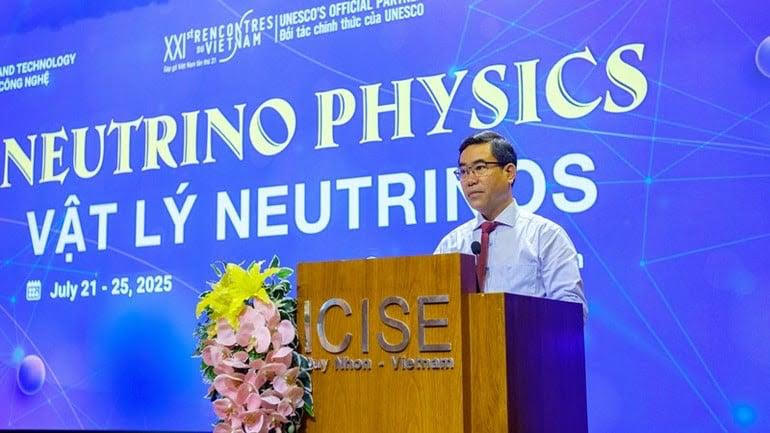

Vietnam’s engagement with the global neutrino research community has intensified, not through abstract diplomacy, but via direct participation in international scientific collaboration. The recent neutrino physics conference held in Quy Nhơn marked a notable shift. Vietnam is no longer positioned as a peripheral observer in high-energy physics. It is becoming a host for substantive scientific exchange while exploring energy technologies derived from that same research domain.
This shift reflects more than academic ambition. It comes at a time when Vietnam’s national infrastructure is strained by rapid industrialization and rising energy demand. As the country searches for scalable, weather-independent, and infrastructure-light energy systems, the potential alignment between neutrino science and domestic application becomes increasingly pragmatic. Developments in neutrinovoltaic energy generation, particularly those pioneered by the Neutrino® Energy Group, are no longer theoretical constructs. They are engineered technologies entering production with potential deployment across Vietnam’s urban, rural, and maritime sectors.
Global Scientific Focus: Vietnam Hosts the Neutrino Physics Conference
On July 22, 2025, the Vietnam Science Association launched a four-day neutrino physics conference at the International Center for Interdisciplinary Science and Education (ICISE) in Quy Nhơn. The event brought together 60 leading physicists from 18 countries to discuss current directions in neutrino science. The agenda included advanced topics such as neutrino oscillation, lepton mixing, and the implications of neutrinos in cosmological and unified field theories.
Key participants included Professor Takashi Kobayashi, Director of the Proton Accelerator Research Complex in Japan, Professor Masayuki Nakahata from the University of Tokyo, and Professor Tsuyoshi Nakaya, President of the Japan Society for High Energy Physics. From India, Prof. Amol Dighe and Assoc. Prof. Dr. Sanjib Kumar Agarwalla joined the proceedings, contributing to discussions on both theoretical constructs and empirical data from global neutrino detection experiments.
The conference also addressed interdisciplinary intersections between particle physics and astrophysics. Topics included neutrinos from supernovae, cosmic neutrino sources, and their role in multi-messenger astronomy. Sessions on applied science focused on geoneutrinos for Earth tomography and neutrino-based reactor monitoring, both of which are considered tools for energy security.
Dr. Nguyen Huu Ha, Deputy Director of the Gia Lai Department of Science and Technology, stated that the conference would help connect Vietnamese researchers and students with international standards of training and research in neutrino physics. The goal is to build not only capacity but institutional credibility for Vietnam in this technically complex and globally relevant field.
Capacity Building: Vietnam School of Neutrinos (VSON9)
Coinciding with the conference, the Vietnam School of Neutrinos (VSON9) provided intensive training to Vietnamese students and early-career scientists. Founded by Vietnamese physicists working in the United States and Europe, the program is designed to cultivate domestic expertise in particle physics and neutrino research.
Training sessions were conducted with scientific backing from Japanese institutions and academics, including Professor Yuichi Oyama (KEK), Professor Atsumu Suzuki (Kobe University), and Associate Professor Dr. Makoto Miura (University of Tokyo). Students studied the Standard Model, solar and atmospheric neutrinos, detector technologies, and the physics of neutrino oscillations. Practical sessions included simulation work, data analysis from experimental facilities, and investigations into cosmic radiation.
Through these efforts, Vietnam is investing in technical human capital capable of supporting both research and applied industrial innovation. This context provides a scientific foundation for the second key development in Vietnam’s neutrino narrative: the practical application of neutrinovoltaic energy systems.
Infrastructure Limits and the Need for Alternative Energy
Vietnam’s current energy landscape is characterized by rapid demand growth exceeding 8 percent annually, compounded by urbanization and industrial expansion. Cities such as Hồ Chí Minh City, Hải Phòng, and Đà Nẵng face mounting strain on electrical grids. Meanwhile, solar and wind installations, although growing in provinces like Ninh Thuận and Bạc Liêu, suffer from intermittency due to seasonal variability, monsoonal cycles, and inconsistent irradiance.
National planners are beginning to recognize that further grid expansion or fossil fuel dependency cannot address Vietnam’s long-term energy needs. The emerging consensus prioritizes decentralized energy systems that can operate independently of climate, time of day, or geographic remoteness.
Subatomic Energy Conversion: From Neutrino Physics to Neutrinovoltaics
Neutrinos are the most abundant known particles in the universe, with trillions passing through every square centimeter of Earth each second. Their mass, confirmed in 2015 by Nobel Laureates Arthur B. McDonald and Takaaki Kajita, transformed their theoretical irrelevance into a viable avenue for energy interaction. This shift laid the groundwork for neutrinovoltaic systems.
Guided by the vision of mathematician Holger Thorsten Schubart, CEO and majority shareholder, the Neutrino® Energy Group has transformed fundamental physics into applied engineering. By developing advanced nanomaterials composed of alternating layers of graphene and doped silicon, the group engineered structures that respond to interactions with neutrinos and other forms of non-visible radiation by vibrating at the atomic scale. These vibrations generate a continuous, low-voltage electrical potential, which is then amplified and stabilized to produce usable power.
This process, unlike photovoltaic generation, does not depend on light or temperature. It is based on the near-constant interaction between materials and ambient subatomic motion, providing a novel category of autonomous energy production.
The Neutrino Power Cube: Localized Generation Without the Grid
The Neutrino Power Cube represents the most direct and deployable expression of this principle. Measuring 800 x 400 x 600 millimeters and weighing around 50 kilograms, the sealed device generates a continuous net output of 5 to 6 kilowatts. It is designed to serve as a localized generator for off-grid homes, remote clinics, telecom towers, and autonomous industrial equipment.
Its structure separates the power generation units from the control systems, improving reliability and simplifying maintenance. The device requires no fuel, produces no emissions, and is immune to fluctuations in weather or sunlight. In remote coastal settlements, island communities, and mountainous villages in Vietnam, where grid extension remains technically or economically unviable, the Power Cube offers a scalable solution.
Field testing of 200 units is underway to validate design durability and finalize industrial production standards.
Pi Technology: Redefining Electric Mobility
The mobility sector in Vietnam is undergoing rapid electrification, but infrastructure remains a bottleneck. Charging stations are clustered in urban centers, with rural corridors largely excluded. The Neutrino® Energy Group’s Pi Car addresses this directly by integrating neutrinovoltaic membranes into the vehicle’s structural surfaces—including the roof, hood, and doors.
These membranes harvest ambient energy while the vehicle is in motion or parked, providing up to 100 kilometers of range from one hour of environmental exposure. AI-driven power optimization developed by Simplior Technologies manages onboard generation and distribution. Materials engineering from C-MET Pune and battery integration by SPEL Technologies Pvt. Ltd. complete the system.
This is not a conceptual showcase. It is a working design prepared for deployment, especially suitable for Vietnam’s interprovincial road networks, port-side logistics, and inner-city fleets.
Pi Nautic and Pi Fly: Energy Independence Across Transport Modes
The Pi platform extends beyond road vehicles. Pi Nautic adapts the same energy conversion materials to the marine environment. Neutrinovoltaic panels integrated into hulls or upper decks of vessels generate energy for electronic systems, auxiliary propulsion, and navigation. Vietnam’s fishing fleet and inter-island ferries represent an ideal deployment scenario, particularly in the South China Sea and the Trường Sa archipelago.
Pi Fly brings neutrinovoltaics to lightweight aviation. Embedded within composite airframes, the technology allows for extended drone and small aircraft operations, reducing the need for ground recharging and enhancing autonomy. Relevant applications include coastal monitoring, precision agriculture, and emergency deliveries in remote areas.
Retrofit Solutions for Existing Vehicles
To enable widespread adoption, the Neutrino® Energy Group offers retrofittable neutrinovoltaic films for existing EVs and hybrids. These thin, flexible materials can be installed on body panels and interior surfaces to provide supplemental energy generation.
In dense urban networks such as Hồ Chí Minh City’s logistics sector, these modifications extend operational uptime and reduce reliance on fixed infrastructure. For consumers, they offer a new framework for energy independence, redefining how charging is conceptualized.
Neutrino Life Cube: Combined Utility for Remote Locations
Electricity is not the only critical utility in remote or off-grid environments. The Neutrino Life Cube integrates a Power Cube with air-to-water extraction and environmental conditioning. It can generate up to 25 liters of potable water per day from ambient humidity while simultaneously providing 1 to 1.5 kilowatts of power.
This integrated system supports disaster response teams, mobile research outposts, and rural clinics. The Life Cube has been included in the UN SDG Cities Program under the Global Innovations initiative and contributes to Sustainable Development Goals 6 and 7.
Project 12742: Neutrino-Based Communication
In addition to energy generation, the Neutrino® Energy Group is investing in next-generation communication technologies. Project 12742 is a €500 million initiative aimed at encoding data into neutrino streams. Because neutrinos can pass through dense matter without scattering, they offer a potential pathway for secure communication across underwater, subterranean, and obstructed environments.
Vietnam, with its maritime zones, mountainous terrain, and distributed infrastructure, could benefit from this kind of communication technology. It introduces new possibilities for national security, marine telemetry, and resilient civilian infrastructure.
Material Science Advances: Two-Dimensional Metal Integration
Recent developments in material science have increased the efficiency of neutrinovoltaic systems. Chinese researchers have succeeded in creating ultra-thin two-dimensional metals, such as bismuth and tin, using a method called van der Waals squeezing. These metals exhibit high conductivity and responsiveness to subatomic excitation, making them compatible with graphene-based conversion layers.
The result is thinner, more efficient neutrinovoltaic modules that can be integrated into consumer devices, architectural materials, and flexible electronics.
Industrial Scale-Up and Regulatory Integration
Vietnam’s Directorate for Standards, Metrology and Quality is actively reviewing compatibility standards for the Power Cube. Regulatory agencies in maritime and aviation sectors are assessing Pi Nautic and Pi Fly configurations against international certification criteria.
These steps are essential for widespread adoption and alignment with global safety and performance benchmarks. They also support the potential for domestic assembly, maintenance, and R&D operations, creating industrial and employment spillovers within Vietnam.
Economic and Environmental Co-Benefits
Neutrinovoltaic deployment supports decarbonization and pollution reduction by eliminating combustion, fuel logistics, and particulate emissions. It also strengthens local economies by creating jobs in nanomaterials fabrication, diagnostics, installation, and predictive maintenance. In energy-insecure regions, these systems provide a reliable baseline that decouples electricity access from geographic or weather-related constraints.
A Physics-Led Model for Infrastructure Autonomy
Vietnam is positioning itself at the intersection of scientific credibility and engineering application. From hosting international neutrino conferences and investing in domestic talent, to assessing the deployment of neutrinovoltaic systems in real-world settings, the country is participating in a major shift in energy and communication paradigms.
Technologies such as the Power Cube, Pi Car, Life Cube, and Project 12742 represent not speculative concepts but working systems built on validated physics. As these systems progress from prototype to industrial deployment, Vietnam has the opportunity to redefine its infrastructure not by expanding what already exists, but by adopting systems that function continuously, independently, and invisibly.
Neutrinos, once deemed unreachable, are now part of the equation for energy and communication sovereignty.
Related
Discover more from Vietnam Insider
Subscribe to get the latest posts sent to your email.
Source: Vietnam Insider