

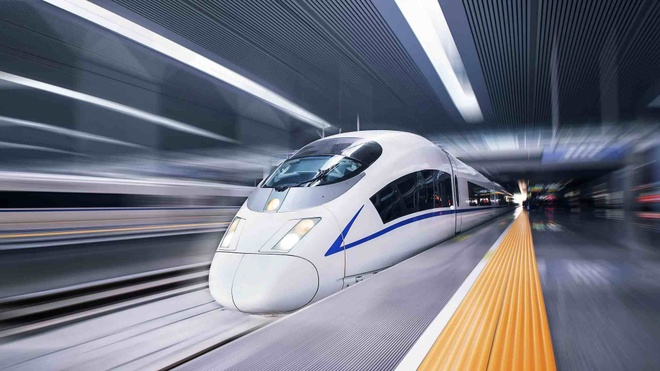

Vietnam’s government has approved plans to build two high-speed railway lines, including the long-discussed North–South Express Railway and a new Hanoi–Quang Ninh route, marking a major step toward modernizing the country’s transport infrastructure.
According to a decision signed by Deputy Prime Minister Tran Hong Ha, the updated National Railway Network Master Plan for 2021–2030, with a vision to 2050, adds the 124-kilometer Hanoi–Quang Ninh high-speed line to the national strategy.
Two new-generation rail routes
The North–South high-speed railway, stretching 1,541 kilometers from Ngoc Hoi Station (Hanoi) to Thu Thiem Station (Ho Chi Minh City), remains the backbone of the national rail system.
Meanwhile, the newly approved Hanoi–Quang Ninh line will begin at Co Loa Station (linked with Hanoi’s Metro Line 4), run through Gia Binh International Airport in Bac Ninh, and terminate at Ha Long Xanh Station in Quang Ninh Province — connecting to the planned Hai Phong–Ha Long–Mong Cai railway.
Vingroup proposal and investment details
Earlier in July, Vingroup proposed building the Hanoi–Quang Ninh line as a 350 km/h high-speed rail, designed for passenger transport with a standard gauge (1,435 mm) and full electrification.
The proposed alignment would pass Co Loa – Gia Binh – Hai Phong – Yen Tu – Ha Long, requiring around 308 hectares of land and an estimated investment of US$5.4 billion (VND 133 trillion). The project is targeted for completion before 2030.
The route will include four main stations — Co Loa, Gia Binh, Yen Tu, and Ha Long — with a potential fifth stop at Yen Vien if the alternative alignment is approved.
Additional upgrades and connectivity
The revised plan also advances several previously postponed rail projects to be completed before 2030, including:
-
Hanoi–Dong Dang (Lang Son) dual-track railway (156 km)
-
Hai Phong–Ha Long–Mong Cai dual-track line (187 km)
-
Thap Cham–Da Lat and An Binh–Saigon (Hoa Hung)–Tan Kien lines
Vietnam will also upgrade seven existing national railway routes, focusing on the North–South high-speed line and connections to major international seaports in Hai Phong and Ho Chi Minh City.
In addition, new links are planned to China, Laos, and Cambodia, as well as domestic transport hubs like Nghi Son Port (Thanh Hoa), Hiep Phuoc Port (HCMC), and airports including Tan Son Nhat, Long Thanh, and the proposed second Hanoi airport in Gia Binh.
Toward a modern transport future
The government aims to transform Vietnam’s rail system into a regional transport hub, integrating high-speed, urban, and international routes to support economic growth and sustainable mobility.
Related
Source: Vietnam Insider