

Vietnam’s economy has officially surpassed Iran in nominal GDP, highlighting a major shift in the global emerging-market landscape.
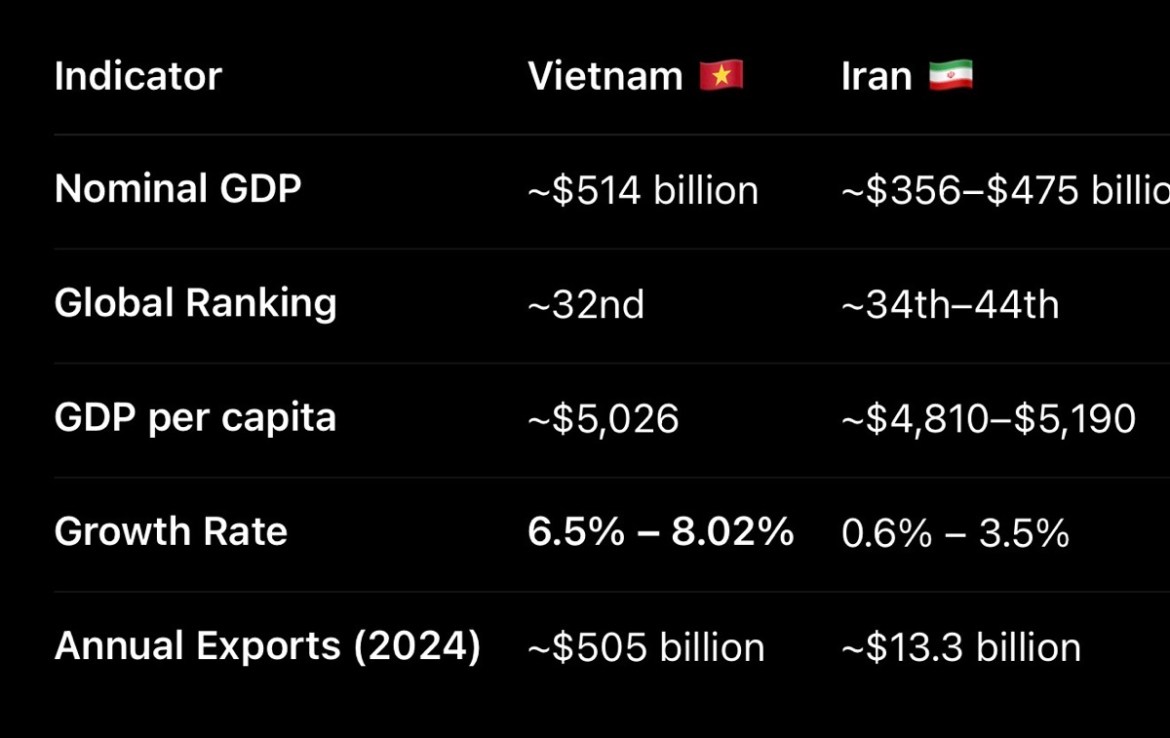
New projections for 2025–2026 indicate that Vietnam has reached an estimated $514 billion economy, placing it ahead of Iran, whose nominal GDP is estimated between $356 billion and $475 billion.
The milestone reflects the rapid rise of Vietnam’s export-driven growth model and deeper integration into global supply chains, while Iran continues to face economic headwinds tied to sanctions, inflation and geopolitical tensions.
Economic Snapshot: Vietnam vs Iran (2025 Estimates)
 100vw, 1024px”></figure>
<p class=) Vietnam’s export value alone is now larger than the entire GDP of several mid-sized economies and vastly exceeds Iran’s export base, which remains concentrated in energy products.
Vietnam’s export value alone is now larger than the entire GDP of several mid-sized economies and vastly exceeds Iran’s export base, which remains concentrated in energy products.
What’s Driving Vietnam’s Economic Surge
1. Strong Growth Momentum
Vietnam recorded economic expansion of around 8% in 2025, making it one of the fastest-growing emerging markets globally. By contrast, Iran’s growth remains modest amid structural constraints and geopolitical pressure.
2. Manufacturing and Export Dominance
Vietnam has evolved into a global manufacturing hub, exporting electronics, textiles, machinery and consumer goods to major markets including the U.S., Europe and Asia. Export turnover reached roughly $505 billion in 2024, almost 38 times larger than Iran’s export value.
3. Macroeconomic Stability
Vietnam has maintained inflation around 3–4%, supporting purchasing power and investment confidence. Iran, meanwhile, continues to struggle with inflation exceeding 40%, which has weakened the domestic currency and constrained economic expansion.
4. Foreign Direct Investment
Strong inflows of foreign direct investment have transformed Vietnam’s industrial base, with multinational corporations relocating manufacturing supply chains to the country as part of broader Asia diversification strategies.
PPP Perspective: Iran Still Larger on a Different Metric
When measured using purchasing power parity (PPP), Iran’s economy remains significantly larger, estimated at roughly $1.9 trillion. Lower domestic prices and extensive energy subsidies boost Iran’s PPP figures.
However, PPP does not necessarily translate into global trade influence or financial market integration, where Vietnam’s export capacity and supply-chain role give it far greater economic leverage.
The Strategic Outlook
Vietnam is increasingly positioning itself among the world’s key emerging economies. Policymakers aim to push the country into the top 30 global economies by 2030, with GDP per capita projected to reach $7,500–$8,500.
For Iran, the trajectory will depend largely on geopolitical developments—particularly the easing of sanctions, stabilization of inflation and structural economic reforms.
Vietnam’s ascent past Iran in nominal GDP underscores the power of export-led industrialization, macroeconomic stability and global supply-chain integration.
As Asia’s manufacturing map continues to evolve, Vietnam is emerging as one of the region’s most dynamic economic success stories.
Related
Discover more from Vietnam Insider
Subscribe to get the latest posts sent to your email.
Source: Vietnam Insider