

As global supply chains continue to shift in response to geopolitical tension, cost inflation, and an urgent need for diversification, Vietnam has become one of the most strategic manufacturing destinations in the world. By 2026, the country’s industrial ecosystem will be more mature, technologically capable, and export-oriented than at any point in its history. For companies seeking to outsource manufacturing overseas, Vietnam offers the ideal balance between cost efficiency, production flexibility, and long-term resilience.
This complete guide walks you through the essentials of outsourcing manufacturing in Vietnam, from finding reliable suppliers to evaluating factories, validating costs, managing quality, and building a durable supply chain for the future.
Why Vietnam Has Become a Global Outsourcing Hub by 2026
In the span of a decade, Vietnam has shifted from a low-cost manufacturing alternative into a key strategic hub for global companies. The combination of rising production costs in China, trade policy uncertainties, and multinational companies adopting a “China+1” strategy accelerated this shift. Vietnam’s government played a crucial role by investing in infrastructure, promoting export-oriented zones, and signing free trade agreements that opened to the EU, UK, and CPTPP markets.
The labor force has also evolved. Vietnam’s workforce is young, increasingly skilled, and adaptable to medium-to-high complexity manufacturing in fields such as home goods, furniture, metalwork, electronics assembly, apparel, and consumer products. Professional factory management teams with international exposure are now more common, further strengthening Vietnam’s competitiveness.
The country also benefits from strong political stability and predictable economic policies, both critical factors for long-term outsourcing planning. This video gives a clear, visual overview of the full journey of finding factories, assessing capabilities, managing quality, and navigating production in Vietnam, a practical complement to the detailed insights covered in this article.
Is Vietnam the Right Choice for Your Outsourced Manufacturing?
Before committing to Vietnam, companies must assess whether the country aligns with what they need today and what they expect their supply chain to become over the next decade. Vietnam excels in categories that require craftsmanship, assembly, mixed materials, and mid-level engineering. It is an excellent choice for companies that value flexibility, cost control, and export-quality production.
However, businesses manufacturing ultra-high-volume commodity goods or highly specialized technical components may need hybrid strategies that combine both China and Vietnam. Vietnam’s strength lies in its balanced ecosystem, not necessarily in producing everything in-house, but in building flexible value chains that take advantage of regional capabilities.
If your objective is to diversify, stabilize your supply chain, or enter Southeast Asia with long-term scalability, Vietnam is likely a strong fit.
How to Find the Right Manufacturing Partner in Vietnam
Finding suppliers in Vietnam requires more a simple online search or a walk through a trade show. The most successful manufacturers in Vietnam are often not the ones that advertise aggressively online. Many mid-size factories with strong export capacity operate quietly and rely on long-term clients or sourcing partners for new business.
A structured search process typically begins with mapping industries relevant to your product. For example, the furniture cluster is heavily concentrated in Bình Dương and Đồng Nai; metal work in Đồng Nai and Hà Nam; plastics in Hồ Chí Minh City; and apparel across multiple provinces like Long An, Đồng Nai, and Hải Phòng. Electronics assembly and EMS manufacturing continue to grow in Bắc Ninh, Hải Phòng, and Thái Nguyên.
For a deeper dive into Vietnam’s manufacturing landscape, download FVSource’s comprehensive “Vietnam Manufacturing in 2026” White Paper. It provides actionable insights on supplier search, cost benchmarks, and supply chain strategies to help you plan your next move in outsourcing production.

>> Related article: Outsourcing Manufacturing in Asia for Efficient Scaling of Contract Manufacturing in 2026
After mapping potential suppliers, buyers narrow down a shortlist by comparing factory size, export history, production lines, certifications, and product specializations. This stage requires a careful eye, because Vietnamese factories sometimes overstate their capabilities, especially when they want to win new business. That is why on-the-ground validation, either by your internal team or a local sourcing partner, is essential before moving to sampling or pricing.
Supplier Vetting: Verifying True Capability
Vetting is one of the most important steps in outsourcing manufacturing to Vietnam. It allows you to distinguish between suppliers who genuinely match your technical needs and those who present well but lack execution capacity.
A proper vetting approach examines the factory’s real production workflow, workforce structure, engineering capabilities, machinery age, and process control systems. It also evaluates whether the factory has meaningful experience in your specific product category, not just adjacent industries.
Vietnam offers a wide range of suppliers, from modern, well-managed factories with strong documentation to smaller, more traditional workshops that require guidance. Evaluating communication ability is also crucial. Some suppliers produce excellent quality but struggle with English proficiency or documentation, while others excel in communication but outsource parts of production to subcontractors.
Effective vetting ensures you work only with partners capable of delivering consistent quality on time.
Conducting Supplier Audits in Vietnam
A supplier audit in Vietnam goes beyond visual inspections. It includes structured evaluation of workflow, quality checkpoints, compliance, storage conditions, material traceability, management systems, and engineering accuracy. Many factories follow good manufacturing practices but do not always document them thoroughly. The audit reveals where gaps exist and provides a realistic picture of what to expect during mass production.
For example, an audit might uncover that a factory has strong assembly lines but lacks preventive maintenance schedules, or that it manages quality visually without adequate measurement tools. These insights help buyers anticipate where risk is likely to arise and plan accordingly.
Audits also strengthen negotiation. When you understand a supplier’s strengths and limitations, you negotiate pricing and timelines with more clarity and fairness.
Understanding Vietnam Manufacturing Costs in 2026
Vietnam remains cost-competitive, but understanding the cost structure is crucial for accurate decision-making. While labor savings are significant compared to China or Mexico, labor is only one component of pricing. Many materials: metals, certain plastics, high-grade textiles, and electronics, are imported, which means global market conditions affect local costs.
Companies must analyze how much of their bill of materials (BOM) is sourced locally versus internationally. A supplier may offer attractive labor costs but rely heavily on imported components, causing prices to fluctuate.
Additional cost elements include tooling or mold creation, packaging development, sample fees, compliance testing, and logistics adjustments. Some factories require design refinement, especially for complex products, which adds engineering time to the budget.
Transparent cost breakdowns early in the engagement prevent misunderstandings later and help set realistic expectations for production margins.
Quality Control: The Foundation of Successful Outsourcing
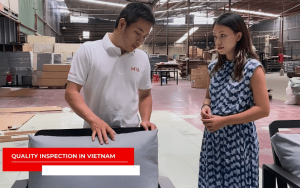
 100vw, 800px”></p> <p id=) The Vietnam-based sourcing agency is conducting quality control for its client directly on-site at the factory
The Vietnam-based sourcing agency is conducting quality control for its client directly on-site at the factory>> Related article: North vs South Vietnam for Manufacturing: A Strategic Comparison Guide for Businesses
Quality control remains one of the most important parts of outsourcing manufacturing to Vietnam. Even strong factories can produce inconsistent batches without structured oversight. Vietnam’s manufacturing industry is evolving, and while many suppliers maintain high-quality standards, others require more guidance to achieve consistency.
An effective QC strategy includes pre-production alignment, detailed product specifications, sample approval, material checks, in-line inspections, and pre-shipment inspections. Products intended for the US or EU markets may require lab testing to ensure compliance with safety standards.
The key is not to rely solely on factory self-reporting. Transparency improves dramatically when buyers maintain active communication and regular quality checkpoints. This reduces delays, rework, and unexpected quality issues.
Timeline for Outsourcing Production to Vietnam
The timeline for outsourcing varies by product type. Simple products may enter mass production soon after samples are approved, while complex items may require extended engineering stages. A typical outsourcing timeline includes supplier search, factory vetting, sampling, tooling development, pilot production, QC checks, and shipment preparation.
Rushing the timeline often leads to preventable errors: incorrect specifications, weak materials, or overlooked technical details. Setting a realistic timeline improves supplier performance and ensures smoother production cycles.
Building Long-Term Supply Chain Diversification in Vietnam
For many companies, Vietnam is not simply an alternative manufacturing location, it is a core part of a broader diversification strategy. Some adopt a hybrid model, keeping early-stage materials or components in China while shifting assembly or finishing processes to Vietnam. Others move entire product lines into Vietnam for cost, compliance, or risk mitigation reasons.
Developing a long-term strategy requires clear forecasting, documentation, and consistent order volumes. Factories in Vietnam perform best when they can plan capacity and allocate resources predictably.
Companies that invest early in supplier relationships gain priority access, better pricing stability, and more consistent production windows.
Vietnam’s OEM Manufacturing Landscape in 2026 : Tips for Sourcing your Own Product
Common Outsourcing Challenges in Vietnam
Although Vietnam offers significant advantages, it is not without challenges. Some factories have inconsistent documentation. Others require development before they can scale to international expectations. Communication delays can also occur, especially during peak production seasons. Engineering capabilities vary widely, and some suppliers struggle with complex tolerance requirements or advanced finishing techniques.
Understanding these challenges is essential. Companies that approach Vietnam with a structured, hands-on process consistently achieve better outcomes than those who rely solely on online research or factory promises.
Clear communication, detailed specifications, and regular quality control are the foundation of successful outsourcing.
Free Trade Agreements and Their Role in Outsourcing
Vietnam benefits from multiple free trade agreements that give exporters preferential access to major markets. These agreements reduce tariffs, streamline customs processes, and enhance Vietnam’s competitiveness. However, buyers must understand the rules of origin to avoid customs delays. Documenting where materials are sourced and confirming compliance with local processing requirements are essential steps.
Factories familiar with FTA requirements provide smoother export operations and fewer unexpected costs.
Conclusion
Outsourcing manufacturing to Vietnam has evolved far beyond a cost-saving solution. Today, it is a strategic cornerstone for companies looking to enhance resilience, improve operational efficiency, and diversify their global production footprint. As Vietnam’s manufacturing ecosystem becomes more sophisticated, supported by stronger engineering capabilities, improved infrastructure, and a growing network of internationally compliant factories, businesses have more opportunities than ever to shift meaningful portions of their supply chain into the country.
Yet, Vietnam is not a plug-and-play environment. Success depends heavily on how well companies prepare. Conducting structured supplier searches, validating true capabilities, understanding cost structures, and maintaining disciplined quality control are all essential steps to ensuring the relationship with Vietnamese manufacturers is sustainable. The country offers tremendous upside, but that value is only fully unlocked when buyers take a professional and proactive approach.
As global supply chains continue to undergo major transitions in 2026 and beyond, Vietnam stands out as one of the most reliable and scalable manufacturing bases in Asia. Companies that invest early, choose partners carefully, and build long-term relationships on the ground will be best positioned to benefit from Vietnam’s rise. With strategic planning and consistent oversight, outsourcing to Vietnam can become a transformative competitive advantage, one that strengthens your operations, improves cost structure, and builds long-term supply chain resilience for the future.
Related
Discover more from Vietnam Insider
Subscribe to get the latest posts sent to your email.
Source: Vietnam Insider