

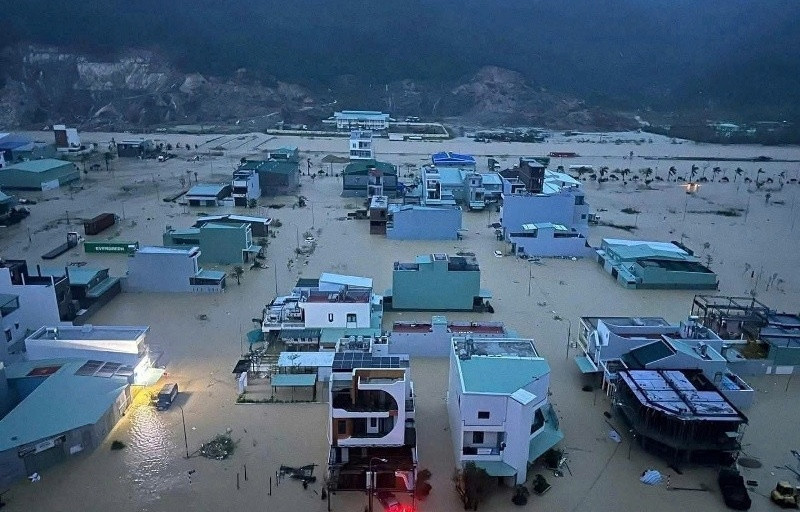

Experts in Vietnam are raising concerns about how hydropower reservoirs are operated after a series of sudden water releases caused severe flooding in downstream communities during recent storms in central Vietnam. They say the problem does not come from extreme weather alone. It also comes from structural conflicts of interest, rigid operating rules, and large legal gaps in dam safety management.
Nguyen Quoc Dung, a leading water resources expert and Vice Chairman of the Vietnam Committee on Large Dams, says many hydropower reservoirs are operated at half full levels during storms. When heavy rain arrives faster than expected, operators are forced to release large volumes of water in a short time. This creates sudden surges that hit downstream areas with little warning.
He notes that many reservoirs have very limited flood control capacity. Some hold up to eight hundred million cubic meters of water but allocate less than ten percent of that volume for flood regulation. Operators want to keep water levels high to ensure power generation. Lowering the reservoir too early risks losing revenue if the expected rain does not arrive.
This creates hesitation. When state agencies issue broad or unclear instructions, such as asking a plant to release between zero and five thousand cubic meters per second, operators may release only a small amount at first. When water rises quickly late in the day, they open the gates all at once. The result is a sudden wall of water that leaves downstream residents with no time to react.
Dung says the government must pair technical requirements with financial compensation. If a reservoir is ordered to release two hundred million cubic meters to prepare for a storm, there should be a clear mechanism to offset the revenue loss. He suggests using the national disaster prevention fund. Without this, private operators will always be reluctant and the system will remain risky.
He adds that hydropower plays a much larger role in flood impacts than irrigation dams in central Vietnam. Many hydropower projects were approved with electricity generation as the top priority and flood control only as a secondary function. Climate change and rising disaster risks mean this approach must be revised. Flood reduction should be a mandatory primary objective.
Dung also says Vietnam can deploy real time flood maps linked to location data. These tools can show exactly which areas will be flooded, how high the water will rise, and how many people are in danger. This would allow faster, more targeted evacuations.
Another issue is the lack of regulation for new types of dams, such as tourist dams and mine tailing ponds. Recent incidents in Lam Dong show that these structures fall outside existing legal frameworks. Dung urges Vietnam to develop a comprehensive Dam Safety Law, similar to India’s model.
Other experts say managing water resources by river basin, not by administrative boundaries, is essential. They also welcome the recent decision to merge Vietnam’s agriculture and environment ministries, a move they believe will help unify data, policies, and dam operations.
For now, the latest floods have revealed a deeper structural problem. As long as hydropower revenues depend on keeping reservoirs high and as long as dam operators face unclear or conflicting instructions, downstream communities will remain vulnerable to sudden floods.
Source: Vietnam Insider