

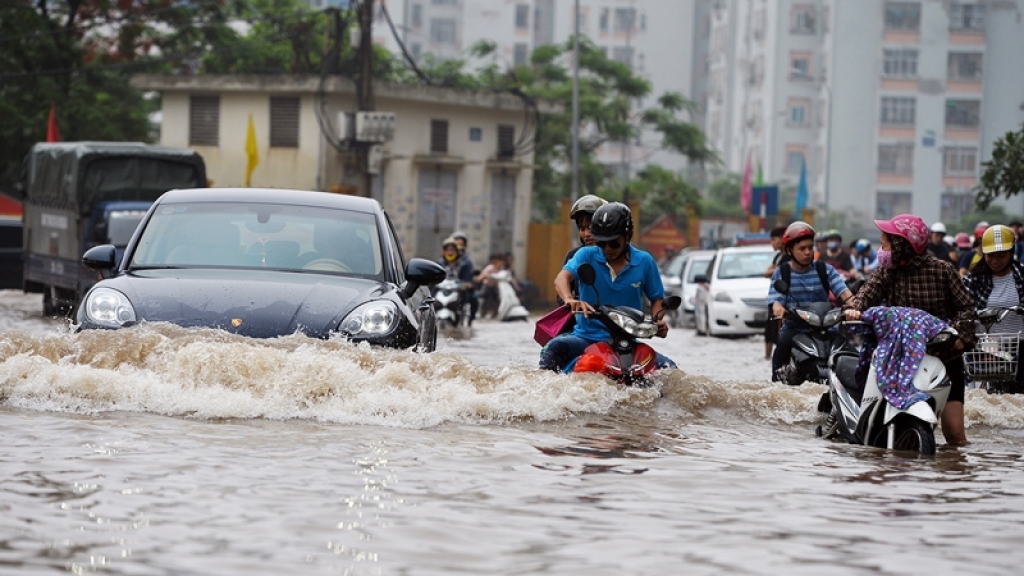

After days of torrential rain brought by Typhoon Bualoi’s circulation, motorbike repair shops in Hanoi have become some of the busiest places in the city—so busy, in fact, that locals are jokingly calling mechanics the “kings of all trades” this storm season.
At 6 a.m. on October 1, mechanic Nguyen Quyet opened his shop on Doi Can Street earlier than usual, fully aware of the hectic day ahead. “Yesterday’s rain lasted from morning until late afternoon, and many people only made it home late at night due to flooding. This morning, they rushed to get their bikes fixed in time for work,” he explained. By dawn, his phone was already ringing with customer calls, some as early as 5:30 a.m.
Flooding Leaves Hanoi Struggling
Heavy rains on September 30 left more than 80 flooded spots across Hanoi. By the morning of October 1, over 20 areas—including Duong Dinh Nghe, Hoa Bang, Phan Van Truong, Vo Chi Cong, Phuc Xa, and the Thang Long Boulevard underpass—remained waterlogged.
For motorbike owners, the floods meant a costly inconvenience. Quyet shared that minor water damage repairs, such as draining water, replacing spark plugs, and cleaning air filters, typically cost around VND 500,000–600,000 (USD 20–25). However, if riders attempted to restart their bikes with water inside the engine, it could lead to bent connecting rods or even broken pistons—pushing repair costs into the millions of dong (hundreds of U.S. dollars).
By midday, Quyet’s shop was still packed with bikes waiting their turn. The situation was mirrored across the capital, with some garages so overwhelmed that they temporarily stopped taking new customers.
“Good Business, But Only Seasonal”
While the surge in demand brings a significant boost in income—Quyet admitted that “a single rainy day’s earnings can equal half a month’s income in normal times”—he also acknowledged the challenges ahead.
Hanoi is preparing to ban gasoline-powered motorbikes within Ring Road No. 1 starting July 1, 2026, under Prime Ministerial Directive 20. This policy aims to reduce emissions and ease congestion, but it poses uncertainty for traditional mechanics like Quyet.
Electric bikes, which feature sealed engines without exhaust pipes or air intakes, are far less vulnerable to flood damage. Yet, their maintenance presents its own difficulties: spare parts are harder to source, and repairs often require specialized knowledge.
“Motorbike repair during storm season may seem like a golden job now,” Quyet said, “but the future will be very different.”
As climate change continues to intensify extreme weather, motorbike repair remains a resilient, if seasonal, business in Hanoi. But with Vietnam’s looming transition toward electric vehicles, the city’s mechanics may soon have to adapt—or risk being left behind.
Related
Discover more from Vietnam Insider
Subscribe to get the latest posts sent to your email.
Source: Vietnam Insider