


Vietnam’s capital accelerates low-emission zones, setting one of Southeast Asia’s most aggressive timelines for phasing out fossil-fuel two-wheelers.
Hanoi has taken a major step toward reshaping urban mobility — and tackling some of Southeast Asia’s worst air pollution — by approving a phased ban on gasoline-powered motorbikes within its urban core. The move signals Vietnam’s intent to align with global clean-air policies already seen in Tokyo, Paris, and Seoul, while raising critical questions for millions of commuters and the region’s booming ride-hailing economy.
In a vote on November 26, the Hanoi People’s Council passed a resolution establishing low-emission zones (LEZs), replacing a 2024 framework and tightening restrictions. Beginning July 1, 2026, motorbikes and mopeds running on fossil fuels will be restricted by time windows or fully banned from designated areas inside Ring Road 1, covering central districts such as Hai Bà Trưng, Hoàn Kiếm, Ba Đình, and Tây Hồ.
The plan will be phased in over four years. From 2028, LEZ rules will expand to parts of Ring Road 2, including Láng, Kim Liên, Bạch Mai, and Vĩnh Tuy. By 2030, the restrictions will apply from Ring Road 3 inward, effectively limiting gasoline-powered two-wheelers across most of Hanoi’s dense urban districts. From 2031 onward, local communes are encouraged — and eventually required — to establish LEZs where conditions permit.
The new rules also prohibit fossil-fuel motorbikes used for app-based ride-hailing services from entering LEZs, a move that will directly impact platforms like Grab, XanhSM, and Be. Heavy trucks over 3.5 tons running on fossil fuel will also be banned from affected zones, and cars not meeting Euro 4 emissions standards will face time-based restrictions. The city will no longer approve new registrations for fossil-fuel vehicles belonging to organizations when older units are scrapped.
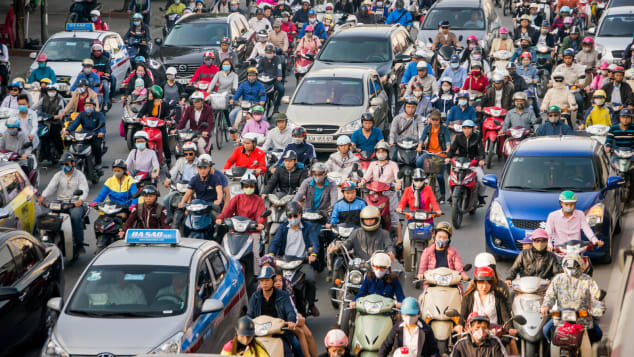
Hanoi, a city of more than 7 million motorbikes, consistently ranks among the most polluted capitals in Asia. Officials argue that reducing the dominance of gasoline two-wheelers — the primary source of transport-related emissions — is essential to improving public health and meeting Vietnam’s climate commitments.
But the policy shift carries economic implications: the motorbike industry remains central to Vietnam’s consumer market, and ride-hailing fleets support hundreds of thousands of informal workers. The transition to electric vehicles will require major investment in charging infrastructure, subsidies, and regulatory clarity.
Hanoi’s bold timeline raises a defining question for rapidly urbanizing Southeast Asian cities: can governments balance clean-air ambitions with economic realities — and will residents embrace an electric-mobility future as quickly as policymakers expect?
Related
Discover more from Vietnam Insider
Subscribe to get the latest posts sent to your email.
Source: Vietnam Insider