

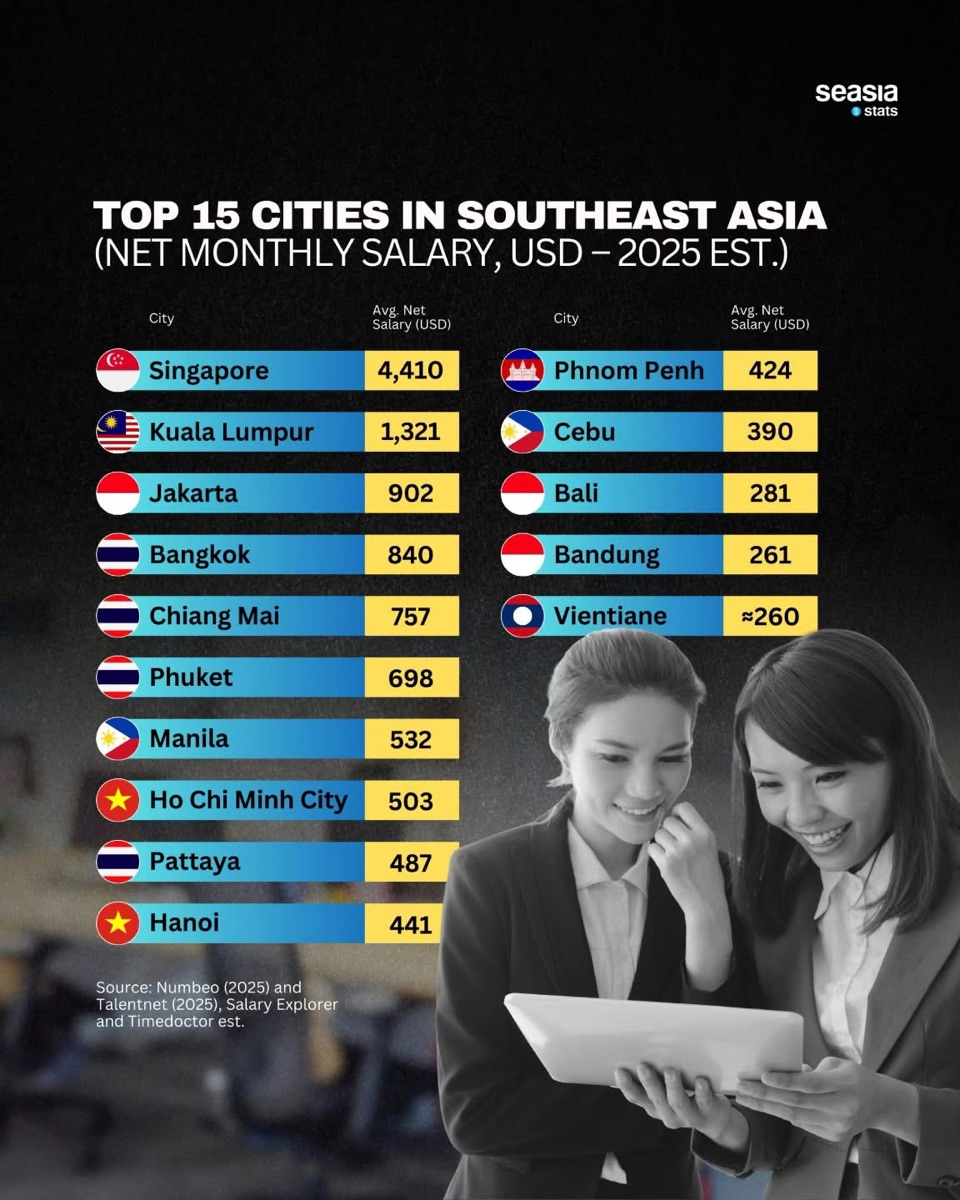
Hanoi and Ho Chi Minh City have been named among the Top 15 Southeast Asian cities by net monthly income in 2025, according to a comparative salary survey by Numbeo, Talentnet, Salary Explorer, and Timedoctor.
The findings underscore sharp disparities across the region, shaped by differences in economic development, cost of living, and labor market dynamics.
Singapore Remains Far Ahead
Leading the list by a wide margin, Singapore reports an average monthly net salary of USD 4,410. As a global financial hub with a thriving technology and services sector, the city-state continues to attract top talent and sustain one of the highest standards of living in Asia.
Malaysia, Indonesia, and Thailand Form the Middle Tier
Kuala Lumpur ranks second with USD 1,321, though still far behind Singapore. Jakarta follows in third at USD 902, reflecting Indonesia’s expanding economy and rising urban employment. In Thailand, major cities stand out with relatively competitive wages: Bangkok (USD 840), Chiang Mai (USD 757), and Phuket (USD 698), supported by strong tourism and digital-driven industries.
Vietnam and the Philippines: Growing but Modest Salaries
In the next tier, wage levels remain comparatively modest. Manila (USD 532), Ho Chi Minh City (USD 503), and Hanoi (USD 441) illustrate the gradual upward trajectory of Vietnam and the Philippines, economies with significant growth potential but lower average earnings compared to regional leaders.
Other Regional Economies Reflect Wider Gaps
Elsewhere in Southeast Asia, cities such as Phnom Penh (USD 424), Cebu (USD 390), Bali (USD 281), Bandung (USD 261), and Vientiane (≈USD 260) underscore the persistent economic divides within the region.

While Vietnam’s two largest cities fall on the lower end of the rankings, the inclusion of Hanoi and Ho Chi Minh City among the top 15 highlights their growing importance in the regional labor market. With ongoing foreign investment, digital transformation, and industrial upgrading, salaries in Vietnam are expected to rise steadily in the years ahead, narrowing the gap with regional peers.
Related
Discover more from Vietnam Insider
Subscribe to get the latest posts sent to your email.
Source: Vietnam Insider