

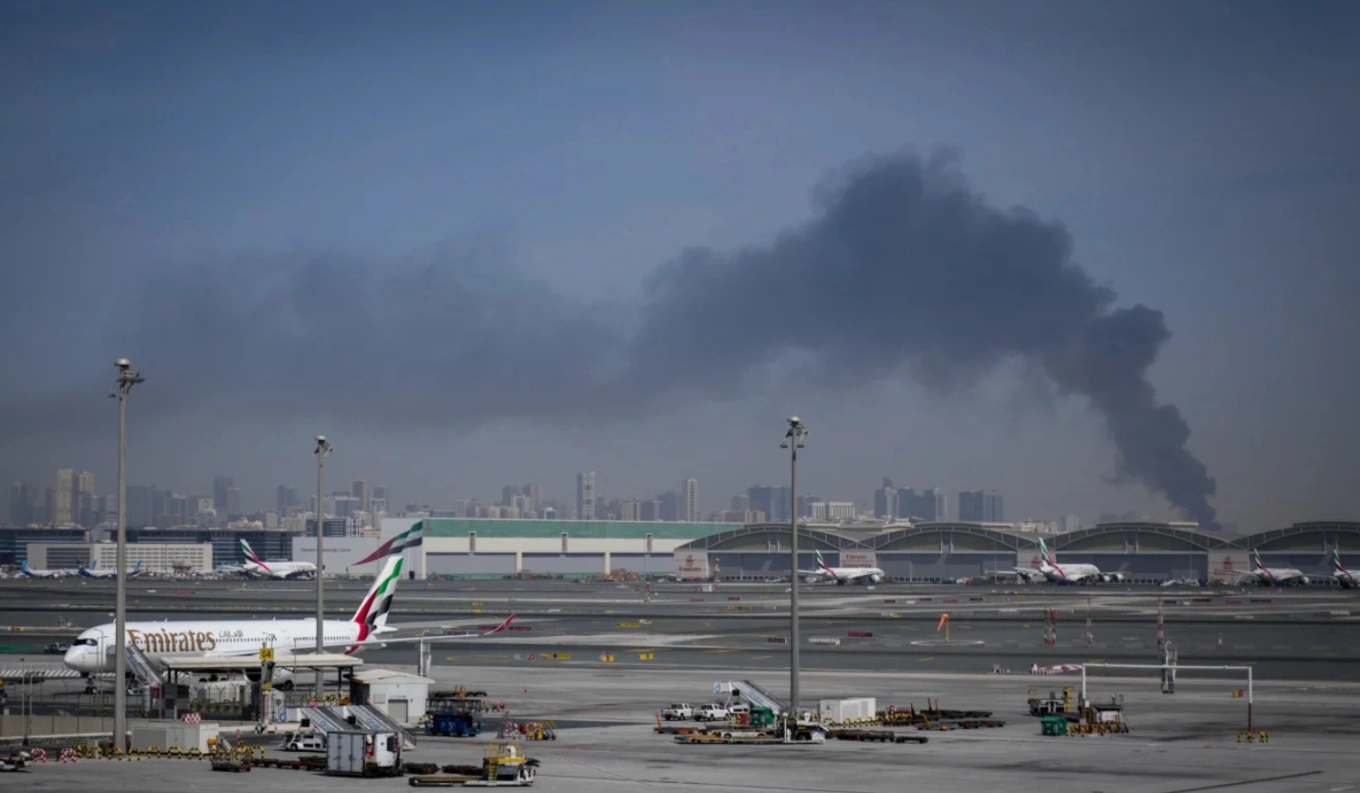

A widening conflict in the Middle East is forcing airlines worldwide to reroute flights, cancel thousands of journeys, and absorb rising operational costs—creating what analysts describe as a massive “hole in the sky” over one of the world’s busiest air corridors.
Flight tracking data from Flightradar24 shows a striking gap in commercial air traffic across parts of the Middle East—normally one of the densest aviation crossroads linking Asia, Europe, and Africa.
For airlines that rely heavily on these routes, the disruption could translate into billions of dollars in losses if the situation continues.
A Critical Aviation Crossroads Disrupted
For decades, flights between Europe and Asia have relied on Middle Eastern airspace, which hosts some of the world’s largest aviation hubs.
Major airports in the region include:
-
Dubai International Airport (UAE)
-
Zayed International Airport (Abu Dhabi)
-
Hamad International Airport (Qatar)
These hubs support global airlines such as:
-
Emirates
-
Qatar Airways
-
Etihad Airways
Their business models are built around connecting passengers traveling between the East and West.
But with parts of the region’s airspace now restricted due to escalating tensions involving the United States, Israel, and Iran, that system has been severely disrupted.
Tens of Thousands of Flights Cancelled
Since the start of the latest escalation, major Gulf airports—including Dubai, Doha, and Abu Dhabi—have experienced widespread disruption.
According to Flightradar24 data:
-
More than 21,000 flights have been cancelled
-
Airport closures have lasted several consecutive days
-
Tens of thousands of passengers have been stranded
The impact stretches far beyond the Middle East, affecting global airline schedules and cargo networks.
Airlines Forced Into Costly Detours
When airlines cannot fly through a major corridor, they must reroute flights along alternative paths.
Analysts say the closure of Middle Eastern airspace is comparable to losing a high-capacity bridge connecting Europe and Asia.
Tony Stanton, consulting director at Strategic Air in Australia, explained that when this “bridge” disappears, flights are forced into two narrow alternative corridors:
These routes quickly become congested.
The result:
A Complex Global Ripple Effect
Airlines cannot simply choose any new route.
Every flight path requires overflight permissions from multiple countries, meaning carriers must renegotiate access to airspace they previously did not use.
Operational complications include:
-
Crew scheduling disruptions
-
Aircraft repositioning
-
Additional airport and refueling costs
-
Hotel accommodation for stranded crews
In extreme cases, some long-haul flights may even need mid-route refueling stops, adding further expense.
Echoes of Past Aviation Shocks
The current disruption is reminiscent of several major aviation crises in recent decades:
-
COVID-19 pandemic (2020), which halted global travel
-
Russia–Ukraine war (2022), which closed Russian airspace to many Western airlines
-
Icelandic volcanic eruption (2010), which shut down transatlantic flights for days
But some analysts believe the current Middle East situation could become the largest aviation disruption since the pandemic if it continues.
Paul Charles, CEO of luxury travel consultancy PC Agency, warned that global cargo transport alone could lose billions of dollars.
Rising Costs and Possible Ticket Price Increases
Fuel already accounts for 30–40% of airline operating costs, meaning longer routes significantly increase expenses.
While ticket prices have not surged immediately, analysts say prolonged disruption could force airlines to raise fares to offset higher fuel and operating costs.
Demand patterns are already shifting.
According to a Reuters survey, bookings on alternative routes—such as Hong Kong to London flights avoiding Gulf hubs—are increasing, pushing fares higher.
Safety Remains the Top Priority
Despite the financial pressure, aviation experts say airlines will prioritize safety above all else.
Major carriers rely on risk assessment systems, intelligence reports, and government advisories before deciding where flights can safely operate.
“Large airlines have structured risk assessment systems and dedicated security teams,” Stanton said.
“If airlines like British Airways, Qantas, or Emirates decide a route is safe to operate, I trust the process behind that decision.”
Uncertain Timeline for Recovery
How quickly global aviation recovers will depend largely on how long Middle Eastern airspace remains restricted.
If the region fully reopens, airlines could restore normal operations relatively quickly.
But if only partial airspace access returns, the global network may continue operating under longer routes, delays, and higher costs.
For now, the “hole in the sky” over the Middle East remains a stark reminder of how geopolitical conflicts can ripple across the global travel and logistics system almost instantly.
Source: Vietnam Insider